
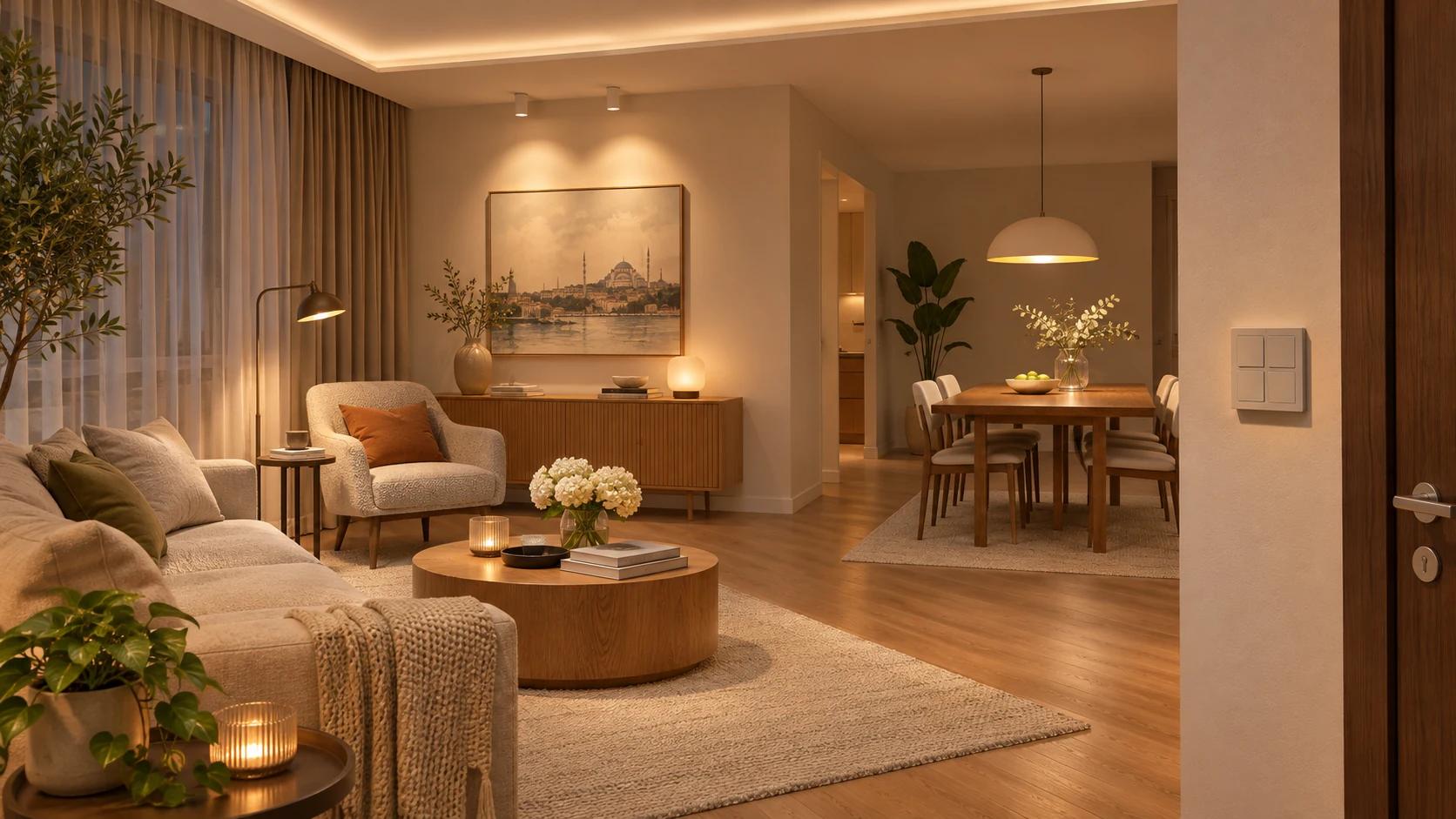
Home lighting in Istanbul starts with room activities and the furniture plan, followed by light distribution, controls and coordination with ceilings, joinery and services. Describe what each scene should do, who uses it and the product, compatibility, maintenance and review information it needs. Discuss a solution with SMD Decoration that the household and guests can understand, with responsible specialists developing technical design, installation and checks for the actual property.
This guide concerns interior lighting and control. It complements the Istanbul façade, landscape and outdoor lighting guide. Design, drawings and coordination can be discussed through SMD’s engineering services. The appointment identifies actual supply, installation, programming, checks and support. The article does not provide wiring instructions, electrical system selection or a recommendation for one automation platform. The useful starting point is the function the home needs, not a list of connected devices.
Write activities before counting fittings
List arrival, dining, reading, viewing, work and cleaning in each relevant space. Explain what should be visible, who uses the scene and how it starts and ends. An evening conversation does not necessarily use the same arrangement as cleaning. Dining may happen while someone works elsewhere in the room, so simultaneous activities belong in the brief. This tells the designer what the layout should support before decorative fitting positions become fixed.
Connect the brief with furniture, windows, curtains and retained elements. Sofa, table, bed and cabinet positions affect lighting and controls. If furniture changes, review the related information rather than keeping an outdated service plan. Ask SMD what you want to see and use before asking how many downlights to buy. The actual room and responsible technical review determine the solution, including product information and any applicable project requirements.
Give each layer a purpose
Discuss general lighting, task light and selected accents with the designer. They need not all operate identically. ERCO’s residential guidance combines general and accent, direct and indirect light within scenes; its control guidance illustrates recalling defined lighting states. These are manufacturer design references, not proof of health outcomes, energy savings, component compatibility or Turkish compliance for your project.
Describe the role of each proposed source: orientation, reading, food preparation or a selected feature. A decorative pendant can be part of the composition without serving every activity. With a purpose recorded, removing or changing a fitting becomes a review of the affected function rather than an arbitrary reduction in quantity. Aim for an understandable relationship between sources and activities instead of filling the ceiling with identical bright points.

Review glare from the actual seat
A fitting that looks attractive from the entrance may be uncomfortable from a sofa or bed. Review source visibility, viewing direction and reflections in screens, mirrors and glossy surfaces. Describe the positions from which the household uses the space. A product’s power or a general warm-light label cannot explain its complete effect in that arrangement. The designer and relevant supplier should assess the actual product and geometry.
Where important, discuss an appropriate sample or scene demonstration before repeating the detail. Review more than one seat and the effect of retained finishes. The owner can explain where a reflection or visible source is troublesome while qualified parties develop the appropriate response. Do not infer a technical result from a rendering. Ask which information, trial or review will support the decision and who is responsible for it.
Compare light with the selected materials
Review important timber, fabric, stone and paint samples alongside the proposed light under suitable project conditions. Ask what the product data and sample demonstrate and what cannot be judged from a phone picture. Terms such as warm or natural are only part of a product description. Identify the actual fitting, finish, optical and control information relevant to the selection rather than relying on the name alone.
Keep a fixture reference linked to its room and selection. When a substitute is offered, ask the supplier and specialist to compare the affected distribution, appearance, dimensions, controls and maintenance requirements. A similar housing does not establish an equivalent result. Update the references after approval so the installed components and material choices can be understood together. This is particularly useful when an owner reviews options from outside Turkey.
Put task light where kitchen activities happen
Identify preparation, cooking, washing and storage, then review how light reaches those activities when the user is present. A body can change the relationship between a ceiling source and the work surface, so discuss task-light options alongside cabinet details. Relevant specialists should assess the actual products, services and installation conditions. The concept is a coordinated kitchen rather than a decorative light strip selected separately at the end.
Identify maintenance access for drivers and other components with the responsible team. Discuss whether task lighting needs separate control from an evening open-kitchen scene and where users operate it. Appliance and joinery information should be coordinated before related work is finalised. Appropriate electrical and wet-area requirements belong with the qualified participants; this article does not specify ratings, connections or mounting methods for the actual kitchen.

Make bedroom controls understandable
Describe entering, reading and moving at night, including the needs of both users where relevant. Review controls in relation to the bed, bedside furniture, headboard and curtains. Phone control may be one option, but ask how the actual household expects to perform ordinary actions. Avoid making a simple lighting task depend on finding an unfamiliar menu unless that is the informed arrangement users have chosen and tested.
For wardrobe light, sensors or automated actions, define the expected behaviour and try it against actual use. A short supplier demonstration does not explain every routine. Clarify starting conditions, adjustment and the appropriate way to override or restore a scene in the selected system. The SMD portfolio can help describe an atmosphere; the controls and product information still need to be developed for the room and its users.
Begin automation with a small set of useful functions
List the functions you genuinely want to discuss, such as lighting and curtains, with any other systems reviewed appropriately for the project. For each, identify the user, desired action, local operation, dependence on an app or connection and support responsibility. Do not select a platform solely because its advertisement lists many possible devices. The brief should explain which of those possibilities has an actual role in your home.
Ask the specialist about current and future needs, including suitable preparation and the boundaries of expansion. Wired and wireless options depend on the premises, functions, equipment and maintenance arrangement. There is no universally preferred system in this guide. A new-build proposal and a limited renovation may have different constraints. Record which information needs assessment before the method and components are agreed, rather than choosing a technology from a promotional picture alone.

Ask what remains usable without the app
Describe essential everyday actions for family and guests, then ask the supplier to explain the selected system’s physical and local control arrangements. What happens if the app, internet connection or another dependency is unavailable? Which functions continue, what changes and how is normal operation restored? The answer is product- and system-specific. A general smart-home label should not be treated as confirmation that all functions operate offline or in the same way.
Agree understandable room and scene names, then try them with users. Arrival, evening and reading can be useful labels if the behaviour behind them is clear. Ask how manual changes interact with automated scenes and any restoration behaviour. Record the actual arrangement for handover. The purpose is a home people can operate with informed expectations, rather than impressive demonstrations that leave everyday users dependent on the installer for routine actions.
Verify compatibility with the responsible supplier
Request confirmation of the chosen components, versions and required functions. Clarify who coordinates lighting fittings, drivers, dimming and controls and who undertakes programming and checks. Two products described as smart are not automatically a compatible system. If a component changes, have the affected combination reviewed before ordering or installation proceeds. Keep the current references and responsibilities together so a last-minute substitution does not silently alter the agreed operation.
Ask about replacement, available support, relevant subscriptions or external services and the information you will receive. The article cannot guarantee a third-party service or product’s indefinite availability. An informed purchase identifies current dependencies and a practical maintenance arrangement. Distinguish supplying equipment from configuring, demonstrating and supporting the completed functions. These boundaries belong in the comparison and appointment rather than being assumed from the number of devices in a package.

Include account ownership in the handover discussion
Identify who should administer the selected system, any temporary installation access and the appropriate process for transferring management to the owner. Discuss secure setup, updates and recovery with the responsible supplier. Avoid putting credentials in a general project document or leaving ownership unclear between unrelated people. The required account arrangement depends on the actual platform and agreed participants; this article does not instruct anyone to alter an existing security configuration.
If entry, sensing or camera equipment is proposed, define the need, locations and use boundaries with relevant qualified parties and applicable requirements. Do not add collection or monitoring simply because it appears in a package. Keep private household activities and legitimate user access in the brief. An automation discussion should clarify the functions users want and the responsibilities they accept, rather than expanding the scope without an explained purpose.
Coordinate ceilings and joinery before closure
Lighting shares space with air outlets, curtains, finishes and maintenance openings. Review them on coordinated information, including levels, actual fixture dimensions and relevant installation needs. Identify elements needing preparation before ceiling or cabinet manufacture. Appropriate specialists determine supports, service requirements and checks. A fitting’s appearance or a generic symbol should not be used in place of product data that affects the actual detail and maintenance arrangement.
Discuss an appropriate fixture, control or circuit schedule for the agreed scope, with supply, installation, programming and checking responsibilities. Link references to drawings and current revisions. When site information differs, resolve the related question before the affected work continues under the agreed process. This supports a clearer construction conversation without turning the article into a wiring recipe or replacing professional design for the selected premises.


Compare complete functions and test the result
Separate fittings, drivers, controls, cables, panels, programming, installation, reviews, demonstration and support as applicable. Clarify the actual currency, validity, relevant taxes or fees and subscriptions in the quotation with responsible parties. A supply-only offer can differ substantially from a configured system. Review the full scope before comparing totals. Energy or operating-cost savings require evidence appropriate to the actual use; a promotional percentage does not establish the result for your household.
Before completion, review the agreed scenes after daylight has gone, from actual seating, working and sleeping positions. Have qualified parties perform required system checks and supplier-defined tests, including relevant local-operation and restoration behaviour. Record observations and closure, then receive the agreed component list, room and scene guide, warranties, support contacts and administration handover. Begin through SMD’s official contact page with furniture plans, site photographs, existing equipment, required functions, services sought, budget and date.
Start your dream project today with SMD Decoration
Your space, your vision. SMD Decoration offers interior design, fit-out and renovation in Turkey and Arab markets: homes, apartments, villas, offices, hotels, restaurants, healthcare, education and exhibitions. Reflect your identity, needs and budget.
Explore finishes, painting, upholstery, custom furniture and lighting in modern, classic, contemporary, industrial or eco-conscious styles. Agree services, execution details and handover before work.
SMD Decoration websites
- Main website: smddecoration.com
- Turkey: smddecoration.net.tr
- Oman, Kuwait & Bahrain: turkiyedecoration.com
- Qatar: smddecoration.qa
- UAE: smddecoration.ae
- Saudi Arabia: smddecoration.sa
- Saudi Arabia — additional site: smddecoration.net
- Libya: smddecoration.info
- Iraq: smddecoration.site
- Syria: smddecoration-syria.com
Bring your vision to life with SMD
Share furniture plans, Istanbul home and ceiling photographs, existing conditions and retained equipment, rooms, activities, required functions, users, budget and target date. Discuss design, coordination, supply, installation, programming, compatibility, local operation, maintenance and handover with SMD, clarifying deliverables, role boundaries, inclusions and exclusions before agreement.