
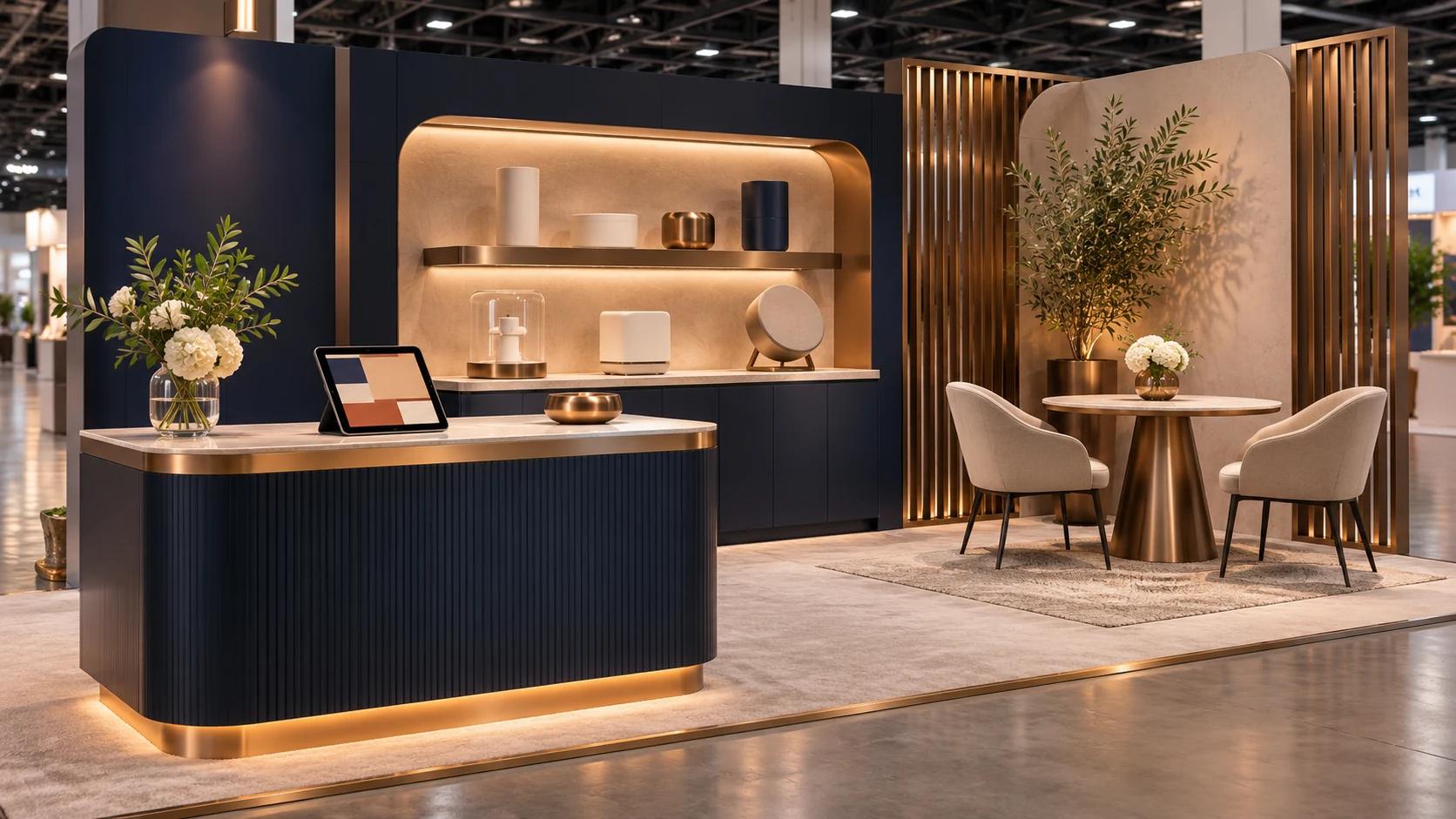
An exhibition stand supports a commercial conversation when its message, product demonstration, qualification questions and agreed next step connect. Plan that journey, prepare the team and define what you will measure. Use the resulting brief to discuss a space with SMD that serves the participation objective without promising visitor numbers, deals or a guaranteed conversion rate.
A busy booth is not sufficient evidence of commercial success. A display may attract attention while visitors leave without the team understanding their needs or agreeing a useful follow-up. Sales-focused booth planning asks what the space helps people understand: who you are, what you offer, whom it suits and how the discussion can continue.
Start with the participation objective, then connect it to the area, product and team's operating method. When discussing SMD's commercial project services, define the roles of the frontage, demonstration, meeting space and storage. This guide focuses on qualification and follow-up, with clear measurement to inform the next participation.
Define the intended outcome before drawing the frontage
Finding distributors, introducing a product, arranging demonstrations and discussing a specific supply need require different messages, materials and questions. Write an observable early outcome, such as a meeting with an organisation whose needs fit the product, rather than relying only on a broad awareness objective.
Then define a relevant enquiry for your business: an intended use, activity type, voluntarily described requirement or a market you actually serve. Qualification need not become an entrance examination. Give the team a practical distinction between an exploratory conversation and an opportunity needing specialist follow-up, while still helping other visitors find useful information.
Make the frontage explain why someone should stop
Visitors need to understand your offer before reading the catalogue. Connect the company name to a specific use or benefit and support it with a product, model or easily explained scene. Give the main message a hierarchy rather than presenting every service at the same visual level.
For example, a supplier of a system for factories can explain its function and intended users first, leaving detailed specifications for the next stage of conversation. SMD's exhibition stand planning guide covers the relationship between message and layout. Apply it here to the buyer's decision journey, rather than choosing a decorative theme without an operating purpose.
Build the demonstration around a buyer's question
Choose what to show by the question it answers: how a component works, its material, the difference between two options or how a service fits the buyer's operation. A physical model may communicate more directly than a long video; a service may need a screen and discussion rather than unrelated samples.
Write a short demonstration scenario: its opening, intended explanation, staff action and what the visitor sees. Prepare a brief introduction and a deeper route for a clearly defined requirement. This supports a consistent message across the team and helps select equipment and space that will actually be used.

Connect interest, conversation and the next step
The visitor should not lose the thread between seeing a product, speaking to a staff member and joining a meeting. Review staff positions, samples and furniture, and how the next step is explained. A meaningful transition can come from functional and visual relationships without a heavy partition at every stage.
| Journey stage | Visitor need | Team preparation |
|---|---|---|
| Introduction | Understand the activity and reason to stop | Clear message and relevant display |
| Exploration | Answer a product or service question | Sample or concise demonstration |
| Qualification | Relate the offer to a real requirement | A few useful questions |
| Detailed discussion | Obtain more specific information | Specialist or organised meeting |
| Follow-up | Agree a next step and contact method | Named owner, timing and suitable material |
This is an operating framework, not a compulsory route. Someone who already knows your company may enter at a later stage.

Use qualification questions that improve the conversation
Start with intended use, then ask what the visitor wants to solve or understand. Their answer may lead to further explanation, a specialist introduction or a later discussion. For an advanced enquiry, ask about timing and requirements the person is comfortable sharing.
Keep the questions flexible and respect information someone chooses not to disclose. A first conversation does not require every possible field, and appearance or language should not be used to infer purchasing ability. Record information relevant to the enquiry and offer a clear follow-up choice. Qualification then supports the exchange instead of interrupting it.
Plan meetings around the discussion they need to support
A standing explanation at the sample may suit an introduction; a negotiation or document review may require a quieter seated setting. Define the purpose before selecting furniture size or a partition. Consider how the specialist reaches a meeting while another part of the booth still needs support.
For a small stand, organise appointments and next steps around the actual programme instead of promising every visitor an immediate meeting. Review screen and document positions when information needs discretion. Discuss these relationships within SMD's architectural and engineering consulting scope, connecting furniture and services to how the space will operate.

Record useful context rather than names alone
A name and contact detail do not explain what the person requested. Add a concise note on the requirement, product discussed, agreed action and follow-up owner, using information the visitor chooses to provide. Explain the purpose of recording it and align subsequent contact with that choice.
Tools such as Cvent LeadCapture offer custom qualification questions. A product feature does not mean the tool is included in your event or integrated with your company's systems. Check the permitted method, licences, access and data transfer arrangements with the responsible parties, and test the workflow before the event. An appropriate structured form can also be considered, with storage and access governed by company policy and applicable requirements.
Rehearse the handoff between team members
Identify who opens the conversation, gives specialist demonstrations, manages appointments and records relevant context. Roles can be flexible; the essential point is that each person knows how to request help and transfer the enquiry without making the visitor start again.
Rehearse a short scenario before opening: a visitor asks about an application, needs a sample and wants to continue the discussion. Test staff positions, access to material and the note-taking step. This may reveal practical gaps in storage, screen content or meeting arrangements. Review SMD's services to define the design and coordination scope; sales-team training and lead management need their own agreed responsibilities.
Agree a specific, achievable next action
The next step may be a specification sheet, remote demonstration, sample request under company policy or meeting with another specialist. Record what was agreed, who will do it and when. Match the material to the discussion that actually took place.
A generic promise to get in touch is difficult to execute when the team has not recorded why or with what information. Sending everyone the same catalogue may not answer the question that brought them to the booth. Prepare materials for common enquiry types, leaving room to tailor the response.
Measure defined outcomes with explicit denominators
Distinguish recorded conversations, enquiries meeting your qualification definition, agreed meetings, quotations sent and deals subsequently confirmed. These are different stages. Do not combine them under one undefined customer count. State the measurement period for each result.
Consider a hypothetical example: the team records 60 conversations, identifies 20 qualified enquiries and agrees a defined follow-up with 8 of those people. Qualification among recorded conversations is 20 divided by 60, about 33.3%. Agreed follow-up among qualified enquiries is 8 divided by 20, or 40%. These are neither SMD results nor a sales forecast, and they say nothing about visitors whose conversations were not recorded. The example shows why the numerator and denominator must be named.

Use observations to improve both design and operation
Repeated questions about a product function may indicate a message or sample worth improving. If an explanation fails because of screen position or missing material, record the situation and cause instead of a general impression. Combine observed operating problems with what the data actually measures.
Avoid attributing sales changes to decoration alone. Event selection, product, commercial offer, staff and follow-up also affect outcomes. SMD's public project portfolio can support a design-language discussion; your participation's specific lessons should inform programme, content and equipment revisions.
Discuss a stand that supports your sales process with SMD
Send SMD Decoration the event, city, hall, dates, plan, stand number, dimensions, open sides and exhibitor manual. Add the product, intended buyer, message, languages, team, meetings, budget, currency and requested work scope.
Ask to discuss a journey from understanding the offer to a clear next step, with suitable relationships between display, explanation, conversation and storage. This connects appearance to everyday use and gives the designer more useful information than a request to attract everyone. A defined audience and discussion purpose make the booth more relevant to the purchasing decision your business wants to support.
Start your dream project today with SMD Decoration
Your space, your vision. SMD Decoration offers interior design, fit-out and renovation in Turkey and Arab markets: homes, apartments, villas, offices, hotels, restaurants, healthcare, education and exhibitions. Reflect your identity, needs and budget.
Explore finishes, painting, upholstery, custom furniture and lighting in modern, classic, contemporary, industrial or eco-conscious styles. Agree services, execution details and handover before work.
SMD Decoration websites
- Main website: smddecoration.com
- Turkey: smddecoration.net.tr
- Oman, Kuwait & Bahrain: turkiyedecoration.com
- Qatar: smddecoration.qa
- UAE: smddecoration.ae
- Saudi Arabia: smddecoration.sa
- Saudi Arabia — additional site: smddecoration.net
- Libya: smddecoration.info
- Iraq: smddecoration.site
- Syria: smddecoration-syria.com
Bring your vision to life with SMD
Send the stand plan, exhibitor manual, event, city and dates, plus the product, intended buyer, message, languages, team, demonstration, meetings, storage, budget and currency. We can discuss a programme connecting the display to a conversation and next step, design and preparation deliverables, operating and follow-up responsibilities, and execution arrangements available before agreement.