
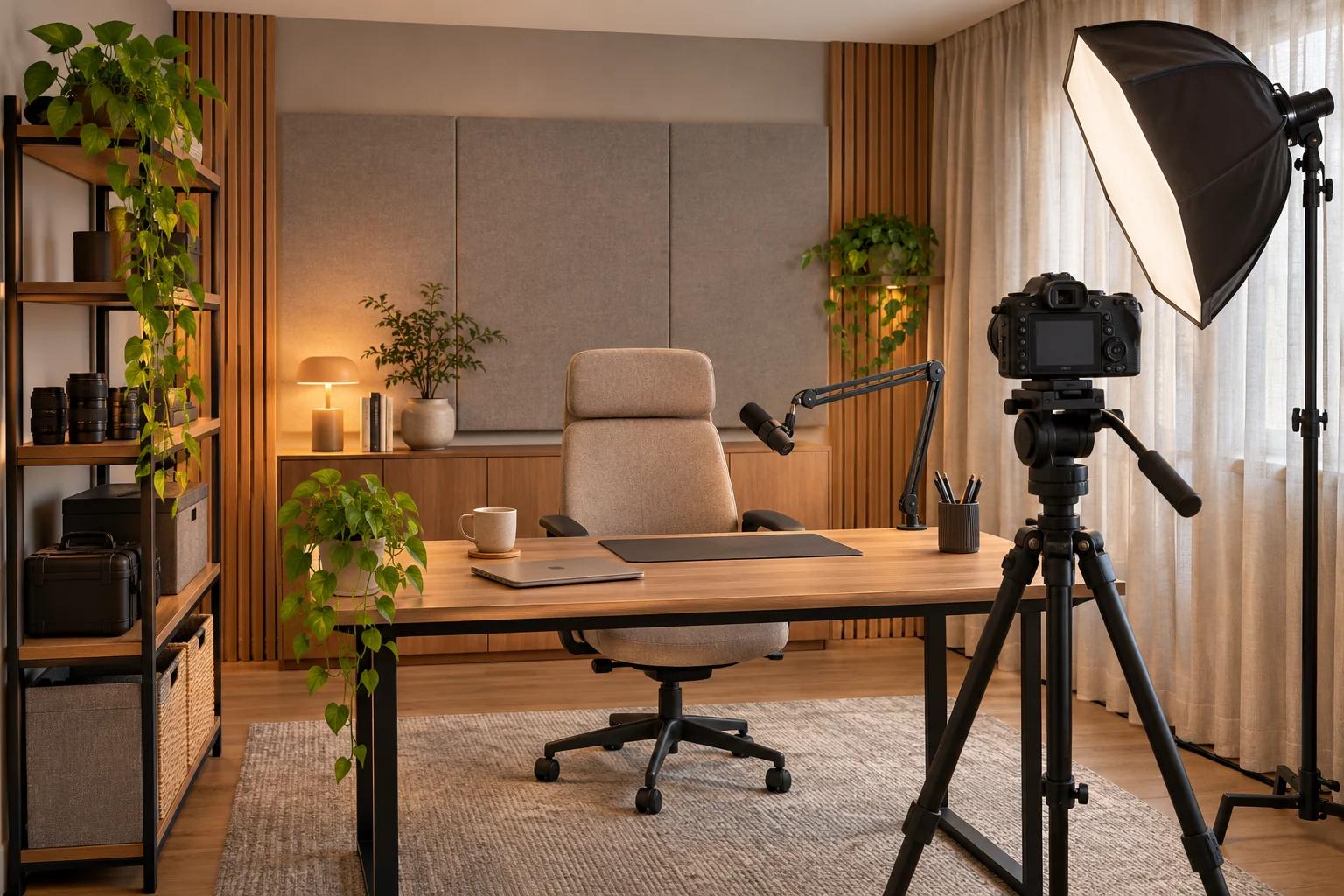
A useful YouTube filming studio supports the way you record: a clear frame, intelligible speech, controllable light and practical space for equipment and movement. Test a recording in the current room, then identify what needs to change in the backdrop, lighting, acoustic treatment and storage. A more expensive camera or more coloured lights will not automatically resolve room problems.
This guide focuses on the physical space and complements the YouTube studio equipment and setup guide. Discuss room planning, joinery, finishes, lighting and coordination with SMD Decoration within a clear scope. Camera supply, audio engineering and technical operation should have their own stated responsibilities rather than being assumed to follow from decoration.
Describe the shot before describing the decor
Identify the number of people, how they sit or move, and whether you present to camera, demonstrate products or record interviews. Those decisions affect the lens, microphone, table and background. Decide whether you need landscape, portrait or both formats; a balanced wide frame can lose its important details in a vertical crop.
- Desk-based teaching needs an appropriate working surface and a frame free of competing equipment.
- An interview needs seating and microphone positions that account for sightlines and overlapping speech.
- Product demonstrations need a surface, backdrop and light that show materials without distracting reflections.
- Standing or moving presentations need actual movement space and room for equipment outside the frame.
Describe a typical episode and test it in the room. A design that photographs well as a still image should also accommodate the activity that takes place throughout a recording.

Survey the room under real operating conditions
Record dimensions, openings, ceiling height, furniture, equipment and available services. Make a test recording at the time you expect to film and with the usual equipment operating. Street noise, an appliance or a reflection may be more apparent in the recording than during a quiet visit.
Record observations before deciding on solutions: an audible device, a window reflected in glasses, or a cupboard door hitting a stand. Investigate the cause and appropriate response. A panel on a wall is not the solution to every recording problem.
For a shared room, list what has to move before a shoot and where it will be stored. Make the setup repeatable instead of requiring a complete rearrangement of the home for every episode.
Test the frame with the actual camera
Try camera height, direction, distance and framing with the equipment you will use. Review picture edges, eye and hand positions, the background and any product demonstration. A wide lens can show more of the room, but it does not create more usable space or make oversized furniture fit.
Check the chair, doors and drawers with stands in their intended positions. Final dimensions depend on the room, equipment and use. There is no universal small-studio size that establishes a working layout for everyone.
AI-assisted room visualisation can support discussion of the appearance. Review the concept against the measured plan and camera test before fixing furniture or lighting.
Create a legible backdrop
Start with one principal feature: a restrained shelf, a calm material surface or an appropriate element of the channel's identity. Assess details through the lens. Something that feels small when standing in the room can compete with a face inside the frame.
Coordinate sheen, colour and texture with lighting. Glass, metal and screens can show unwanted reflections, while clothing can blend into a similar-coloured background. Test physical alternatives instead of approving a palette from an inspiration board alone.
Allow for cleaning, replacement and maintenance. If a channel logo is used, position and size it to serve the composition and use material you have the right to display. Recognition does not require filling the set with logos.

Arrange light around the subject and materials
Begin with controllable light in a useful direction for the face, then evaluate whether you need shadow fill or separation from the background. YouTube's mobile filming guidance recommends soft, even light and identifies a window as one available option. Test the result with the actual camera and room rather than judging by the number of fittings.
If you use daylight, consider how it changes during recording and how it will be controlled. When combining sources, check skin tone, background colour and repeatability across days. Request component information and control compatibility rather than assuming that all dimmable products produce the same recording.
Review a recording for movement, brightness, flicker, reflections and shadows with the selected camera settings. The eye does not reveal every issue visible on video. Relevant specialists should coordinate fixing, power, controls and maintenance access for the equipment and site.
Separate room treatment from noise isolation
Acoustic treatment addresses sound reflections within a room. Reducing sound transfer from a street or another room requires assessment of transmission paths, separating elements, openings and services. Curtains or absorptive panels do not establish complete sound isolation.
Shure explains room sound and acoustic treatment, while WBDG discusses acoustic comfort and sound transmission. These references help distinguish the problem. Materials, installation and technical reviews must be selected for the project rather than copied from an unrelated office or studio specification.
Listen to recorded speech and compare microphone positions. Identify whether the main issue is reverberation, steady equipment noise or sound from an adjacent space before buying treatment. Review material suitability, installation instructions, care and applicable safety requirements rather than covering the room with arbitrary products.

Include the microphone in the layout
Bring the microphone appropriately close for its type and the shot, then test speech level, handling noise, hand movement and the chair. A suitable arm can organise the desk, but its position must work with screens, writing and product demonstrations.
Record the arrangement that passed the test so it can be repeated. With guests, review spacing, movement and recording inputs with the technical operator. An attractive interior does not by itself provide a recording system for every number of speakers.
Plan storage, cables and ventilation
Provide accessible places for lenses, batteries, stands, accessories and demonstration materials. Group the items used for each episode. A smaller display shelf and more closed storage may serve the room better than additional objects inside the frame.
Coordinate cable routes, power and controls with the relevant team and preserve movement and equipment access. Test the arrangement with doors and drawers open and the chair moving, rather than only in a static filming position.
Review ventilation and device noise under real operating conditions, together with how the room remains usable throughout an episode. A quiet short test achieved by switching off equipment needed for the full session does not resolve its operating noise.

A hypothetical shared-room studio
Consider a room of approximately three by four metres used for both a desk and solo filming. These are illustrative dimensions, not a minimum-space recommendation. Identify the openings and retained furniture, then test the camera, presenter position and light before manufacture.
Compare filming towards an organised side shelf with filming towards a simple material wall. Review each in landscape and portrait, with normal operating sound, chair movement and cupboard use. Select the direction that works inside the room rather than judging only a lighting photograph.
Record repeatable decisions after the test: stand location, presenter reference position, microphone arrangement, accepted backdrop and agreed lighting components. Any issue still apparent in the recording remains open until addressed; finishing the decorative work does not close the recording test.
Allocate the budget in useful stages
Start with issues that prevent a clear episode: room suitability, sound and light control, followed by backdrop, storage and visual refinements. The trial determines purchasing priorities. Existing equipment can reveal a room problem that needs a spatial change rather than another device.
Separate design, joinery, finishes, lighting and coordination from cameras, software, subscriptions, training and technical operation. Compare quotations on equivalent quantities, products, installation, exclusions and dates. A universal studio price is not meaningful without the room and production brief.
Use a handover recording checklist
- Episode type, format, camera and lens or phone, and test settings.
- Presenter, microphone and equipment positions inside and outside the frame.
- Lighting scene, components and references needed to repeat it.
- Speech, movement, door use and equipment operation under agreed conditions.
- Picture and sound comments, the responsible person and closure status.
- Equipment list, care, access and operating instructions within the appointment.
Save a reference clip with the plan revision and accepted choices. Use it to document the agreed result, the setup needed to repeat it and remaining comments.
Turn an episode brief into a design package
Send room dimensions and photographs, content type, participant count, current equipment and a reference frame. Discuss the layout, backdrop, joinery, materials and lighting with SMD Decoration. Identify audio, electrical, equipment and operating responsibilities in the agreement. A professional space begins with a useful trial, followed by the details your production actually needs.
Start your dream project today with SMD Decoration
Your space, your vision. SMD Decoration offers interior design, fit-out and renovation in Turkey and Arab markets: homes, apartments, villas, offices, hotels, restaurants, healthcare, education and exhibitions. Reflect your identity, needs and budget.
Explore finishes, painting, upholstery, custom furniture and lighting in modern, classic, contemporary, industrial or eco-conscious styles. Agree services, execution details and handover before work.
SMD Decoration websites
- Main website: smddecoration.com
- Turkey: smddecoration.net.tr
- Oman, Kuwait & Bahrain: turkiyedecoration.com
- Qatar: smddecoration.qa
- UAE: smddecoration.ae
- Saudi Arabia: smddecoration.sa
- Saudi Arabia — additional site: smddecoration.net
- Libya: smddecoration.info
- Iraq: smddecoration.site
- Syria: smddecoration-syria.com
Bring your vision to life with SMD
Send room photographs and dimensions, content type, participant count, current equipment and a reference frame. We can discuss the backdrop, joinery, finishes, lighting and organisation, with clear audio, electrical, equipment and operating responsibilities and agreed design outputs.