
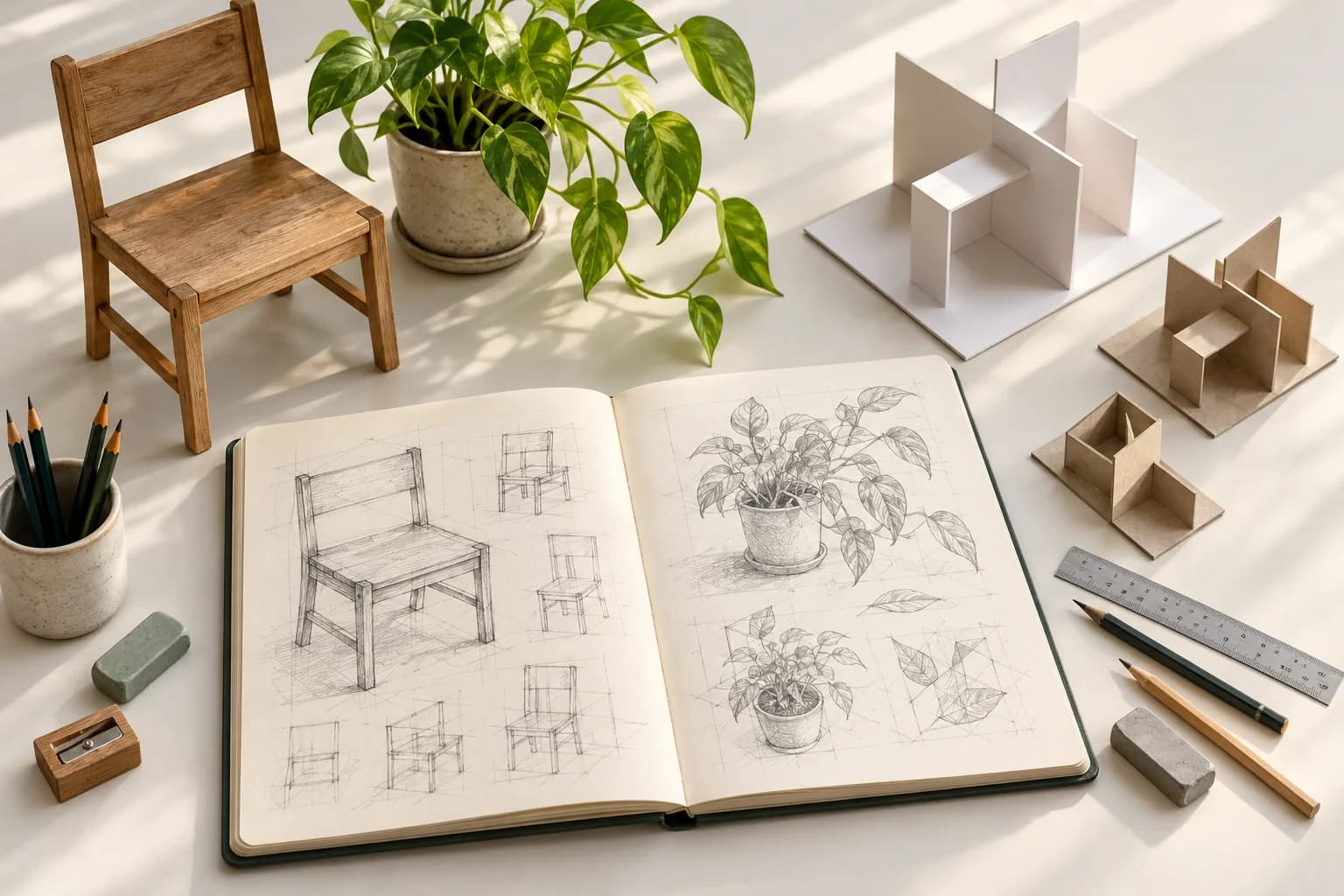
Preparing for architecture admissions starts with the requirements for your chosen course, application year and applicant route. An institution may use a test, portfolio or interview, depending on the programme. There is no universal examination syllabus. Collect the official instructions before planning practice, and avoid assuming that polished software output or a generic study schedule guarantees a place.
Separate admissions from course examinations
An admissions assessment concerns entry to a programme. A course examination assesses learning after enrolment, such as architectural history, structures or studio work. Professional registration is another process with its own responsible bodies. A university module list is not automatically an entrance-test syllabus.
Record the exact degree, institution, country, application year and applicant route, including international or transfer status where relevant. Similar course names can hide different requirements. When instructions are unclear, ask admissions a precise question about the assessment and when its instructions will be issued.
Make a requirements brief before you practise
| Check | Record |
|---|---|
| Course and year | Official URL and review date |
| Eligibility | Route-specific qualifications and documents |
| Additional assessment | Test, portfolio or interview if required |
| Submission | Deadline, time zone, format and file size |
| Rules | Permitted tools, authorship and assistance |
| Arrangements | How to request assessment support |
Keep the instructions and invitation, and record any clarification from admissions. A previous applicant’s experience or an old article cannot replace current course guidance. Do not transfer one university’s page limit, deadline or permitted tools to another.
A documented university example, within its scope
UCL Bartlett describes a requested creative portfolio and interviews for selected applicants. This illustrates one institution’s process; it is not a global admissions model or a requirement for Saudi or Turkish universities. Follow your own invitation for submission instructions and timing.
Match preparation to the assessment you actually face. A portfolio calls for evidence of development; a test calls for careful reading of its published description and tool rules. Do not spend all your time on perspective drawing if your programme asks for something different.
Practise observation and spatial thinking
The following are proposed learning exercises, not real examination questions or university marking criteria. Draw an ordinary chair or plant from observation, focusing on masses, proportions and negative space. Move to a second viewpoint and compare how the visible relationships change.
For spatial practice, fold a small paper model, then draw a top view, side view and simple perspective. Explain where the space is and how someone would enter it. Distinguish a plan, elevation and section; heavy shading should not conceal inconsistent relationships between parts.
Explore architectural terms: plans, elevations and sections

Build a portfolio that explains your decisions
If a portfolio is requested, inventory your original work before selecting examples. Give each piece a title, medium, date and accurate account of your role, especially for group work. Show selected stages: an observation or question, an experiment, an alternative, a revision and a result with a concise explanation.
Avoid repetitive images and work you cannot honestly claim. Clear photographs, a readable sequence and an explained choice are more useful than decorative effects without purpose. Follow the institution’s permitted media, page count and file size. Do not send extra work or external links unless requested.
Software and AI: check the rules and show your contribution
Start with the tools required or permitted in the instructions. Do not buy equipment or a course solely because generic advice claims that advanced software is essential for entry. When using digital tools, be ready to explain the decisions and work you completed yourself.
Check the institution’s policy before using AI or outside assistance. Do not present generated output as an observational hand drawing or personal field research. Retain development evidence and disclose assistance where the policy requires it. Ask for clarification before submission if the rule is unclear.
Use a flexible four-stage preparation plan
| Stage | Reviewable output |
|---|---|
| Confirm | Requirements brief with sources and dates |
| Try | A relevant drawing, model or creative study |
| Revise | Specific feedback and an improved version |
| Rehearse | Practice under stated conditions; file check |
Allocate the stages to your available time rather than treating them as a mandatory duration or a promise of admission. After each session, identify one issue, such as inconsistent proportions or an unclear idea. Make a change you can compare with the previous version. Repeating the same drawing without review is a weak way to track progress.
Prepare to explain your work at interview
If invited, practise discussing a piece in your own words: your starting question, alternatives, chosen direction and what you would change. Choose work whose limitations you can discuss. A rehearsed statement about loving architecture needs concrete examples behind it.
For a remote interview, check the connection, sound, lighting and display method against the instructions. Confirm the link, time zone and required materials. Do not assume a fixed question format or use leaked questions and confidential assessment material.
Review the test conditions and final submission
If a test is required, read the whole task and identify the outputs, time and tools. Practise allocating time to understanding, exploration, execution and checking within the published format. Use officially released practice material when it is available and permitted.
Before submission, open your file on another device and check orientation, order, legibility, size and filename. Confirm that the upload completed and keep the acknowledgement and submitted version. A successful file check establishes a complete submission, not an admissions outcome.
Source and review date
UCL Bartlett: How to apply for undergraduate study. Reviewed 20 October 2026. The institutional example stays within its scope; the exercises and review sequence are educational suggestions developed for this guide. Recheck programme instructions for each application cycle.
Turn a spatial idea into a clear project brief with SMD
For an architectural or interior project, share your plan, photographs, intended use and initial budget so we can discuss the design scope, options and next steps. You can request a free initial consultation; a proposal follows review of the project. Contact the SMD team.
+90 553 904 12 12
Discuss your project on WhatsApp+966 50 498 6649
Discuss your project on WhatsAppEmail: info@smddecoration.com
SMD websites: Main website · Türkiye · Oman, Kuwait and Bahrain · Qatar · United Arab Emirates · Saudi Arabia · Additional Saudi website · Libya · Iraq · Syria.