
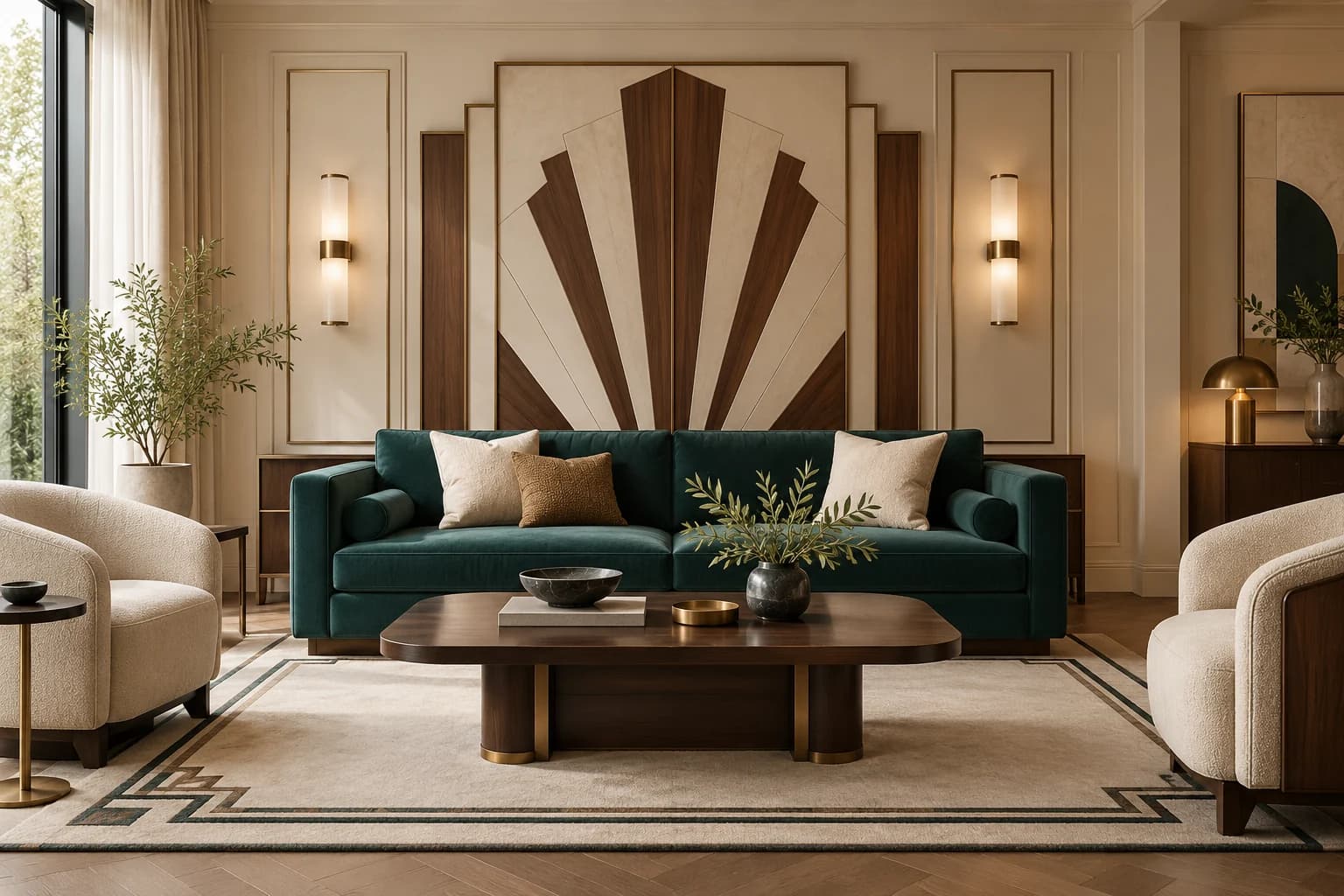
Art Deco offers inspiration through geometric composition, ornament and relationships between colour and materials. A contemporary room does not need to be filled with gold or velvet. Choose a connected design language that suits its use and dimensions. Establish furniture, circulation and a focal point first, then test details and samples before commissioning the work.
Art Deco and the 1925 Paris exhibition
The Metropolitan Museum places Art Deco in the decorative arts and architecture between the world wars. Paris 1925 showcased an already mature international style rather than inventing it overnight. Its name later abbreviated the exhibition’s title. Ornament included geometric, botanical, animal and human subjects.
Calling it an English style is therefore misleading. A style label cannot authenticate an unidentified object. This guide concerns contemporary inspiration; conservation or valuation of an original piece requires provenance and appropriate specialist review.
Historical reference: The Met, French Art Deco, 2010.
A contemporary concept with controlled detail
Start with one defining element, such as the wall behind a seating group or a piece of furniture with intentional geometry. Let other details support it. Compare the lines on walls, rugs and tables without collecting every decorative emblem in one room. The cover and concept below explain this approach; they do not document a period interior.

Art Deco and Art Nouveau: an initial comparison
| Aspect | Art Deco | Art Nouveau |
|---|---|---|
| Context | Closely associated with interwar design | Developed from the 1880s to the First World War |
| Visual language | Geometry and ornament within a broad range | Sinuous lines and natural inspiration are prominent |
| Reading an image | Review composition, detail and provenance where historic | A flower or curve alone cannot establish a style |
This broad comparison draws on the two Metropolitan Museum essays. It supports understanding rather than definitive authentication. Influences can overlap: a curve alone does not make furniture Art Nouveau, just as gold alone does not make an interior Art Deco.
Colour and furniture should serve the room
An ivory background with deep green or blue, or a light-dark relationship with a restrained metal accent, are possible contemporary choices. They are not a mandatory historical palette. Review real samples with the floor, curtains and lighting, and do not infer a material or period from a commercial colour name.
Test sofas, chairs and tables against doors and everyday routes. Formal symmetry should not force furniture into an obstructive position. A single geometric cabinet front or repeated detail can establish the idea alongside simpler existing furniture; replacing everything is unnecessary.
Select the feature relevant to your project
If a richly coloured hospitality interior appeals to you, identify the actual attraction: the geometric floor, panel proportions or lighting arrangement. Test that feature on your home’s plan before combining them all. Scale and circulation differ between a domestic room, restaurant and hotel lobby.
Keep a concise reference board that explains the decision, including what you will leave out to reduce competition. A style name cannot resolve two alternatives; compare everyday use, maintenance and cost.
Specify a product rather than an appearance
Velvet, wood, glass and metal are options to discuss, not a compulsory checklist. Distinguish solid wood, veneer and printed finishes, and distinguish brass from copper or a metal-effect coating. Gold colour does not identify the alloy, finish thickness or durability.
A suitable contemporary product can express the concept without requiring rare or animal-derived materials mentioned in design history. Request a sample, product reference, care instructions and any performance information needed for the project. Gloss does not establish scratch, moisture or fire performance.
Simplify details where space is limited
A clear line treatment on one surface or furniture piece can establish the concept with quieter space around it. Review the size of each detail against its supporting surface. Avoid adding another frame to every door, mirror and table.
Compare a restrained and a more ornamental option on the same elevation. This helps select density rather than deciding from a close-up of an isolated object. Approve material, colour and finish from physical samples rather than the image alone.
Review lighting and reflections in the real setting
Choose fixtures that relate to the composition while serving the required function. Review their light sources and reflections from the seated user’s position. A large crystal chandelier is not compulsory; simpler side lighting or glass details can support the concept when coordinated with the room.
Have the responsible specialist review mirrors, suspended fixtures and cladding with their actual support systems. Images do not establish fixing points, loads or electrical provision. Floor and finish suitability follows product and use requirements rather than the style name.
Turn the concept into a reviewable scope
- Record the survey, dimensions, room use and furniture to be retained.
- Prepare a concise concept board, focal point and scale or density alternatives.
- Develop furniture plans and elevations showing openings, lines and joints.
- List materials, colour, gloss, product references and approved samples.
- Coordinate support, lighting and maintenance with appropriate specialists.
- Separate design, sampling, fabrication, installation and inclusions in the quotation.
- Review a sample detail and inspect handover against the approved revision.
Cost depends on quantities, materials, detailing, procurement and site conditions. Compare equivalent scopes and set spending priorities. Neither a fixed price nor an assumption that all Art Deco-inspired work is expensive follows from the style name. These are proposed SMD steps, not an executed-project record.
References and their limits
The Met: French Art Deco, Jared Goss, 2010 · The Met: Art Nouveau, Cybele Gontar, 2006. Checked 20 October 2026. Source publication dates differ from this review date. Contemporary selection advice is separate from museum documentation of objects.
Plan an Art Deco-inspired interior with SMD
Share room photographs, dimensions, existing furniture and an initial budget so we can discuss composition, materials, sampling and design or implementation scope. Specifications and cost follow review of the details. A free initial consultation is available on request. Contact the SMD team.
+90 553 904 12 12
Discuss your project on WhatsApp+966 50 498 6649
Discuss your project on WhatsAppEmail: info@smddecoration.com
SMD websites: Main website · Türkiye · Oman, Kuwait and Bahrain · Qatar · United Arab Emirates · Saudi Arabia · Additional Saudi website · Libya · Iraq · Syria.