
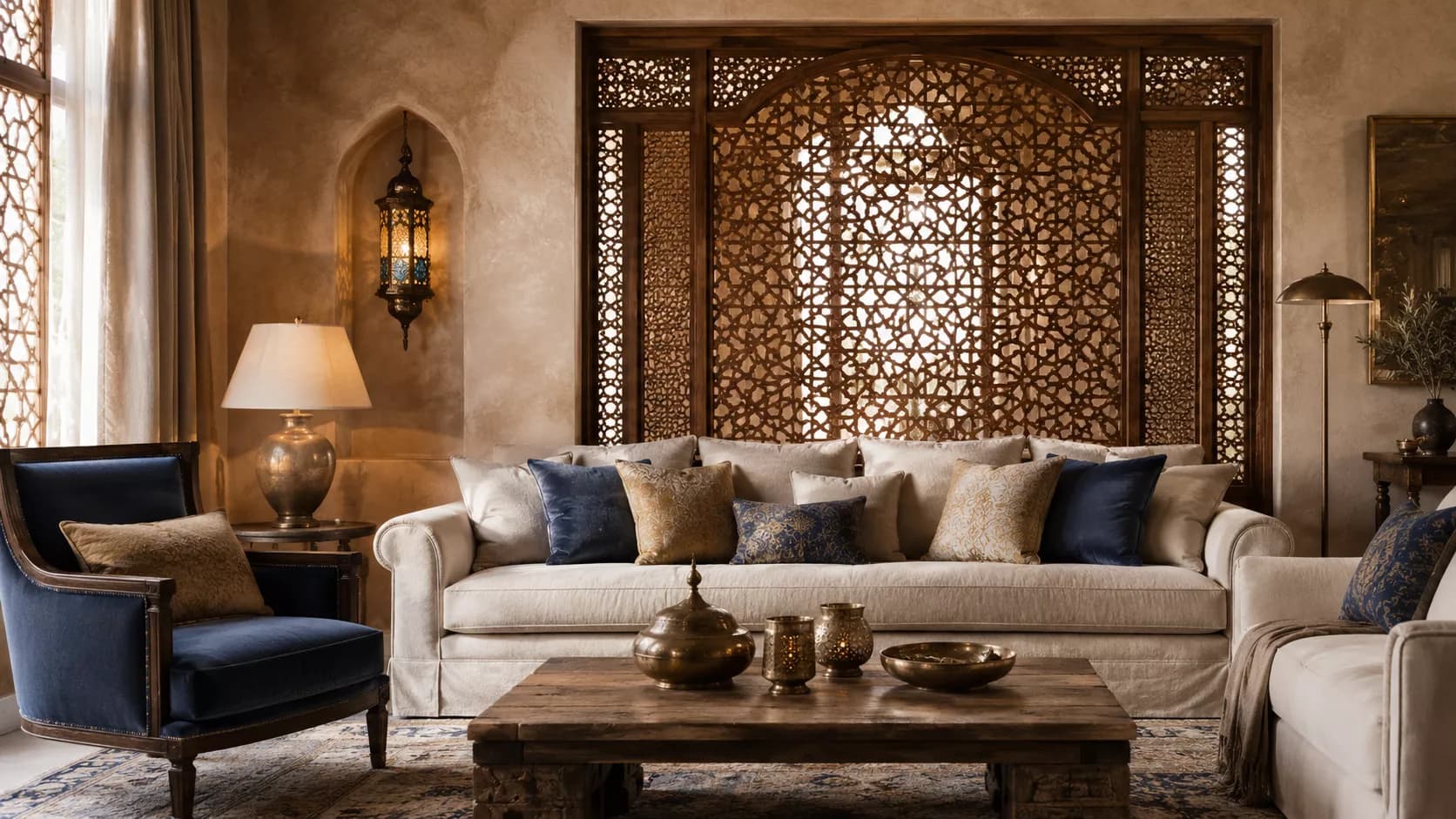
Brussels and Cairo in one house: A dialogue between Egyptian style and quiet Belgian luxury
When Belgium and Egypt meet in Group G of the 2026 World Cup, two worlds of beauty will converge behind them, representing the two poles of the equation of refined design: opulence and tranquility. On one side, there is the Egyptian style of decor, with its inexhaustible cultural richness—three civilizations coexisting in one home: Pharaonic with its gold and lotus blossoms, Islamic Cairo with its mashrabiyas, arabesques, and copperwork, and Nubian with its vibrant colors. On the other side, there is the Belgian style with its quiet luxury that has made Belgium a global benchmark for understated elegance: dusty neutrals, raw linen, aged oak, and patina that elegantly speaks of the passage of time. At SMD Interior Design, we see in this encounter a beautiful dialogue: how Egyptian opulence meets Belgian tranquility, so that cultural richness gains a disciplined edge that highlights it, and tranquility gains a warm, profound depth—giving birth to a luxurious Egyptian decor with a sophisticated, contemporary feel. This guide carefully and respectfully deconstructs the two schools of thought, then shows you how to translate them into your own space.
The Egyptian style is a school of multi-layered cultural richness: Pharaonic (gold, lotus, and alabaster), Islamic Cairo (mashrabiya, arabesque, copper, and stained glass), and Nubian (vibrant colors and mud domes). The Belgian style, on the other hand, is a school of quiet luxury, built on dusty neutrals, raw linen, aged oak, and patina, with an Art Nouveau heritage and traditional Flemish weaving. Both styles converge in their deep craftsmanship, love of natural materials, and sense of time, but diverge in their richness of color and ornamentation versus understated elegance. The ideal recipe for the contemporary Arab home: a quiet Belgian base (70%), aged natural materials (20%), and a heroic Egyptian touch (10%). This guide from SMD Decoration explains the step-by-step application for homes, restaurants, and cafes.
What does this confrontation mean from the perspective of an interior designer?
On the green rectangle, it's a clash between two brilliant generations of footballers; but in the world of design, it's a dialogue between two philosophies representing the extremes of refined taste. Egypt boasts a design heritage unparalleled in the world: a Pharaonic civilization that laid the foundations for architectural beauty, followed by Islamic Cairo with its Mamluk schools of geometric ornamentation, mashrabiya screens, and copperwork, and to the south, Nubia with its mud-brick architecture and rainbow-like colors. From these springs a style overflowing with richness, layers, and stories. Belgium offers a model that is the opposite in direction yet parallel in depth: a school that has made discretion a luxury, and patina, raw materials, and neutrals a refined language sought after by leading designers worldwide under the name "Quiet Luxury," alongside its heritage in the Art Nouveau movement and its rich Flemish textile tradition. The discerning designer doesn't choose between the richness of civilization and the quiet elegance, but rather learns from both: from Egypt, the depth of craftsmanship, the generosity of ornamentation, and the warmth of color; and from Belgium, the wisdom of discretion, the elegance of authentic materials, and a sense of time. Between these two worlds stands contemporary Arab taste, searching for an authenticity that does not shout, and a tranquility that does not cool down.

The Egyptian style: a school of rich and diverse cultures
The Egyptian style of decoration is based on a rare uniqueness: three civilizations converse within its vocabulary. From the Pharaonic era comes gold, lapis lazuli, lotus flowers, papyrus, and Egyptian alabaster with its warm transparency, all of which are inspired in the contemporary Pharaonic style with refined, understated touches (a table base with papyrus columns, a gilded accessory, an alabaster vase) that avoids literal reproduction. From the Islamic Cairene era comes the mashrabiya—those delicate wooden latticeworks that play with light and privacy—along with arabesque inlaid with mother-of-pearl, the hammered copper for which the workshops of Khan el-Khalili are renowned, the stained glass in lanterns and domes that scatter enchanting colors, and Mamluk geometric patterns. From the Nubian era comes the boldness of color: vibrant blues, yellows, and oranges on mud walls, and domes and arches with the spirit of the South. The color palette combines the gold of the Pharaohs with the turquoise and lapis lazuli of Cairo and the vibrancy of Nubia, all set against a desert sandy base. The character is completed by the culture of hospitality: the traditional seating area and the majlis, with coffee at its center. It is a style that celebrates social classes and stories, but—when used well—it is an organized richness, not chaos.

Belgian style: A school of understated luxury
On the other end of the spectrum stands the Belgian style, the world's foremost reference point for what is now known as "Quiet Luxury." Its philosophy rests on a profound conviction: true elegance doesn't shout. Here, superfluous embellishments are discarded, leaving only the raw materials to speak for themselves—aged oak with its natural grain, raw Belgian linen (among the finest in the world), stone, hand-painted plaster, and matte bronze with a patina that speaks of time. The color palette is carefully chosen to whisper: dusty neutrals of gray, terracotta, ochre, and muted beige create a visual tranquility that soothes the mind. But behind this serenity lies a cultural depth: the legacy of the Art Nouveau movement, born in Brussels by Victor Horta, with its flowing botanical lines, wrought iron, and stained glass; Flemish tapestry and Bruges lace crafted with inherited artistry; and the influence of Flemish masters in their understanding of soft light. It is a style that trusts that the finest thing about a space is its stillness, and that the patina and natural texture speak louder than any glitter.

Detailed comparison: 11 items
We read both schools element by element, then summarize them into a single reference table that can be used when designing and purchasing:
|
The element |
Egyptian style |
Belgian style |
|
Philosophy |
A rich, multi-layered cultural heritage: Pharaonic, Cairene, Islamic, and Nubian. |
Quiet Luxury: Subtle elegance and timeless sophistication. |
|
colors |
Gold, lapis lazuli, turquoise and terracotta + lively Nubian touches. |
Dusty neutrals: gray, clay, oat, pale beige. |
|
raw materials |
Copper, mother-of-pearl inlaid wood, stained glass, alabaster, linen. |
Antique oak, raw linen, stone, plaster, patinated bronze. |
|
decorations |
هندسية مملوكية ومشربية ولوتس وبردي ونقوش. |
Veganism, Art Nouveau flowing + mostly muted simplicity. |
|
Lighting |
Copper lanterns and stained glass cast enchanting colors. |
Warm, dim, waxy-looking lighting and soft, natural light. |
|
Furniture |
A table, a mashrabiya, inlaid chairs, and fine gilded pieces. |
Refined rustic oak, linen, simple, calm, antique lines. |
|
Craftsmanship |
Cairo crafts: Khan al-Khalili copper, inlay, glass, textiles. |
Flemish crafts: linen, tapestry, lace, oak carpentry. |
|
Hospitality culture |
Coffee and the gathering/council were the focus of the university session. |
The quiet, intimate gathering, the family table, and the muted warmth. |
|
The employed heritage |
Pharaonic, Islamic, and Nubian — three civilizations in one house. |
Art Nouveau Brussels and the legacy of the Flemish masters and the Patina. |
|
Relationship with nature |
The Nile, the desert, and the oasis; papyrus plants and palm trees. |
Soft northern light, earthy materials, and a quiet, muted nature. |
|
The final touch |
The luster of gold and copper and the richness of stained glass. |
Patina of time and the texture of raw linen And tarnished bronze. |

The raw materials that create the soul
The difference between a space belonging to a specific style and one lacking a distinct identity is created by the interplay of materials. This is the essence of our practical experience with the materials used in this design dialogue:
|
raw material |
In the Egyptian style |
In the Belgian style |
|
wood |
Wood inlaid with arabesque and mother-of-pearl, and finely perforated mashrabiyas. |
Aged oak with natural veins and a raw, unpolished texture; rustic and sophisticated. |
|
walls/surfaces |
Mamluk decorations, copper and stained glass + warm plaster. |
Hand-laid plaster (Limewash) and stone with a calm, dusty texture. |
|
Minerals |
Hammered copper used in lanterns, trays, and coffee pots. |
Matte bronze with a patina finish and Art Nouveau iron, lightly worked. |
|
Glass/Lighting |
Stained glass, colored glass, scatters colors in lanterns and domes. |
Elegant Art Nouveau glass and soft, candle-like lighting. |
|
fabrics |
Egyptian linen and cotton, and fabrics decorated with rich, cultural colors. |
Raw Belgian linen, tapestry fabric, dusty-colored wool. |

Because wood is a central element in both styles—inlaid and decorated in Egypt, and raw, aged in Belgium—our guide on wood types and their properties will help you choose the most suitable type. Lighting is also covered in a separate guide titled " Types of Lighting and Their Importance in Decoration," given the significance of Egyptian stained glass and Belgian soft lighting in creating ambiance. And because both Egyptian and Belgian styles intersect with the spirit of Art Deco and Art Nouveau, our article on the Art Deco style will enrich your reading experience .
The art of blending: Egyptian richness and Belgian tranquility in one painting
The beauty of this encounter lies in its complementary, not contradictory, aspects: wealth needs tranquility to highlight it, and tranquility needs a touch of wealth to enliven it. The secret lies in the 70/20/10 rule we employ in every project, and here it is a sophisticated recipe for integration.
- 70% Belgian tranquility as a rule: walls in dusty neutrals (oat plaster or clay), raw linen, and quiet breathing spaces in the style of quiet luxury — for tranquility is a fabric that highlights what is above it.
- 20% natural aged materials: aged oak, stone and bronze in Patina build a bridge between the two cultures, both of which venerate the authenticity of the material and the sense of time.
- 10% Egyptian hero wealth: a mashrabiya screen, a stained glass lantern, a pharaonic golden touch, or a rug in Nubian colors — here cultural wealth speaks with one confident voice without crowding.
The result is a space where two spirits converge in harmony: the richness of Egyptian civilization atop the serene elegance of Belgian luxury; an authenticity that doesn't shout, and a tranquility that never cools. This is the essence of luxurious Egyptian decor with a modern interpretation, something many of our clients seek. To understand the logic behind building color palettes from the ground up, consult our guide on the color wheel and the principles of color on the SMD blog .

Applying the idea in the living room, majlis, and guest salon
The reception room is the space where this dialogue truly shines, for it blends the generosity of Egyptian opulence with the tranquility of Belgian elegance. Our approach to designing a salon that merges these two styles is as follows:
- The setting is quiet and subdued: walls in dusty neutrals, raw linen in the furnishings, and soft warm lighting that gives the salon an elegant tranquility.
- The hero is Egyptian: a single mashrabiya screen, stained glass lantern, or copper plaque becomes the visual focal point of the salon and the source of its identity and wealth.
- The seating combines the two styles: low sofas in neutral Belgian linen fabrics, topped with cushions in Egyptian cultural colors (lapis lazuli or muted gold), with an antique oak table.
- The coffee corner is the heart of generosity: a coffee corner with copper pots and trays on a tranquil surface — an authentic Egyptian identity piece within a muted Belgian framework.
- Two-layer lighting: a stained glass lantern with a hero scattering warm colors (Egyptian spirit) + soft candlelight and natural light (Belgian spirit).
For more information on seating arrangements and spatial hospitality principles, see our Men's Majlis Design Guide , and for coffee corner ideas specifically, see our Coffee Corner: Ideas and Designs Guide .

Residential spaces: From a tranquil lounge to a luxurious retreat
In villas and houses, this design dialogue allows for a beautiful gradation between the home's spaces: a living room with quiet Belgian luxury (dusted neutrals, linen, aged oak, patina) for tranquil daily life; a reception room celebrating Egyptian opulence with its centerpiece (mashrabiya, brass, stained glass) welcoming guests with rich and confident words; and a private corner with a subtle Pharaonic touch (alabaster vase, gold accessory) that adds cultural depth. This gradation from "daily tranquility" to "receptional richness" gives the house a cohesive, rather than monotonous, character. Our residential projects, developed in Egypt, the Gulf, Saudi Arabia, Turkey, and the wider Arab region, offer living examples of this balance. You can explore them in the residential projects section of our website and watch tours in our video gallery and interactive 360° tours , allowing you to explore the space before making your decision.

Commercial spaces: restaurants, cafes, and hotels
In the commercial hospitality sector, this design dialogue offers a genuine competitive advantage. A restaurant or hotel with an Egyptian ambiance (mashrabiya, copper, stained glass, Pharaonic touches) creates a rich and unforgettable spatial experience that transforms the customer into a volunteer photographer. A café with a tranquil Belgian feel (neutrals, linen, aged oak, subdued lighting) creates a serene and sophisticated atmosphere where the customer lingers. The smartest commercial approach is a combination: a refined, understated Belgian base reduces visual clutter, while prominent Egyptian touches in the facade and photo booth enhance the perceived value of the space. All of this can be implemented with a sophisticated seasonal flair during tournaments, without any tournament or team logos, to maintain legal compliance. SMD has implemented solutions in the hospitality sector, which can be reviewed in the Commercial Projects section . For a deeper understanding of the psychology of color in restaurants, see our article on using color in restaurant decor .

How does SMD apply this idea in practice?
SMD Decoration is an interior design and execution company operating since 2017, from Istanbul to Egypt, the Gulf countries, Saudi Arabia, and the wider Arab region. Our turnkey approach begins with a consultation to understand your taste, space usage, and the size of your event space. We then develop a comprehensive vision—a layout plan, a color palette, and materials based on the 70/20/10 principle, balancing Egyptian richness with Belgian tranquility. We create 3D models that allow you to visualize your living room or majlis before any execution begins. A single team then handles the execution, finishing, and furnishing until your space is ready for you. Whether you prefer the opulent Egyptian style, the serene luxury of Belgium, or a blend of both, we translate your taste into a space tailored to your needs. Learn more about our philosophy and team on our About Us page , explore our portfolio on our Projects page (or by country) , and find answers to your questions on our FAQs page. You can also contact us directly through our Contact Us page or WhatsApp .
Common mistakes when combining wealth and tranquility
- Excessive Egyptian ornamentation: The refined Egyptian style knows when to stop; mashrabiya, copper, and gold on every surface turn into clutter — make the riches the hero in one place, not an all-encompassing cover.
- Exaggerated Pharaonic craftsmanship: literally copying temples turns the house into a cinematic set; contemporary Pharaonic style takes inspiration from the touch (lotus, gold, alabaster) and does not imitate the museum.
- Cool tranquility: Quiet luxury without warm, aged materials becomes a dull void; oak, linen, and patina are prerequisites for its spirit.
- A mix without rules: a random combination of intense Egyptian richness and Belgian tranquility in every corner = chaos without identity; the 70/20/10 rule maintains balance.
- Imitation craftsmanship: Printed mashrabiya, plastic copper, or synthetic linen. Both styles lose their spirit; one authentic piece is worth more than ten imitations.
- Ignoring the patina: The most important lesson from Belgium is that the effect of time is beautiful, not flawed; striving for a perfect shine on every surface kills warmth and spirit.
The best practical app for your home
A realistic plan for incorporating the spirit of this design dialogue into your space, in order of priority:
- Start with a quiet, muted base: walls in dusty neutrals (oat or clay) and raw linen furnishings.
- Introducing the vintage material: an antique oak piece, a touch of stone, and a patina-finished bronze.
- Choose one Egyptian hero: a mashrabiya screen/mirror, a stained glass lantern, a rug in civilized colors, or a copper plaque.
- Add one subtle Pharaonic touch (an alabaster vase or a gold accessory) for a sophisticated cultural depth.
- Set up a coffee corner with copper pots and trays as the heart of hospitality in a tranquil setting.
- Set the lighting with two layers: a colorful, nesting lantern + a soft, warm, dimmable light.
The result: a space that confidently celebrates Egyptian richness and breathes the quiet elegance of Belgian sophistication — a rich, sophisticated identity that befits your guests and puts your day at ease.
Conclusion: A dialogue in which there are neither victors nor vanquished.
The game ends with a score, but the dialogue of design doesn't end with a winner and a loser. Egyptian richness and Belgian tranquility aren't adversaries, but rather teachers, and every elegant home learns from both: the depth of craftsmanship, the generosity of ornamentation, and the warmth of color from Cairo, and the wisdom of discretion, the authenticity of materials, and the sense of time from Brussels. At SMD, we create spaces that unite these two spirits in harmony—a luxurious Egyptian décor that doesn't shout, and a refined tranquility that never grows cold. If this dialogue resonates with you, begin where all beauty begins: with an idea.
Ready for a space that combines the opulence of Cairo with the tranquility of Brussels? Book your introductory consultation via our contact page or directly via WhatsApp. SMD — SMD Decoration | Everything starts with an idea
🏆 Start your dream project today! The SMD Decoration team is ready to turn your vision into reality.
📞 Call us: +966504986649
📧 Email: info@smddecoration.com
🌐 Contact us now: https://smddecoration.com/contact
If you have a question or inquiry, you can find the answer on the Q&A page.
Services provided by SMD Decoration
SMD Decoration | Turkey Decorations | The best interior design company in Istanbul, Turkey
SMD Decoration is an interior design company specializing in interior decoration in Turkey.
We are an interior design company offering a wide range of services in the field of interior design, starting with the design and implementation of Turkish home decor, Turkish decorations for apartments, villas and palaces, and salon decorations.
Even designing and implementing Turkish decorations for commercial projects such as hotels, restaurants, hospitals, schools and universities.
Our designs are characterized by professionalism and passion, and we strive to realize our clients' vision and transform their ideas into a tangible and attractive reality. We believe in the importance of reflecting Turkish identity and culture, as well as Istanbul's décor, in our designs, and we aim to provide our clients with a unique and distinctive experience.
In addition, we offer other services such as installation, upholstery, painting, finishing, renovation and modernization for residential and commercial projects in Istanbul Decor.
We also specialize in the design and implementation of custom furniture and interior furnishings for residential and commercial projects.
We have experience in designing Turkish decorations, implementing interior and exterior lighting in Turkish home decor, and installing electronic systems.
We consider SMD Decoration to be the best decoration company in Turkey, as we provide high-quality services and strive to achieve customer satisfaction.
We work diligently on project implementation, from meticulous planning to final finishing touches, with great attention to detail and precise execution.
SMD Decoration is the best decoration company in Qatar, where creativity and quality are provided in customer service.
SMD Decoration is the best decoration company in the UAE, where interior design and decoration are beyond imagination.
SMD Decoration is the best decoration company in Saudi Arabia and the Arab countries, where innovation and quality are present in every design.
SMD Decoration is the best decoration company in Kuwait, thanks to its experience, efficiency, quality of service, and overall customer satisfaction.
SMD Decoration is the best decoration company in Amman in terms of services, ratings, opinions and prices.
SMD Decoration is the best decoration company in Bahrain, turning ideas into tangible reality.
SMD Decoration is the best decoration company in Libya, where the decoration designs are in line with the latest trends and standards in this field.
SMD Decoration is the best decoration company in Iraq, as it studies various influencing factors to meet customer needs and align with their lifestyles.
SMD Decoration is the best interior design company , as when it receives a specific project it follows up on it from the planning stage in terms of the small details to the final finishing touches.
SMD Decoration is a leading interior design company in Turkey. They offer high-quality space beautification services at competitive prices.
By using the latest technologies and materials, the company ensures the best results for its clients.
The company always aims to meet the needs and desires of customers, and works hard to achieve a design that suits the customer's taste and reflects his personality and needs.
Her professional team works passionately to turn ideas and visions into tangible reality, with great attention to detail and precise execution.
The company believes in the importance of customer experience and strives to ensure complete customer satisfaction.
To contact customer service, please use the customer service numbers.
We would like to emphasize that SMD Decoration, an interior design and decoration company in Turkey, does not use Bitcoin or digital currencies in its business transactions, but accepts payment in paper currency or through bank transfers.
SMD Interior Design and Decoration Company
A leading company in the field of interior design and decoration in Türkiye and the Arab region
SMD Interior Design was founded in 2017 in Istanbul, Turkey. Since then, the company has grown to become one of the leading interior design firms in Turkey and the Arab region. The company offers its services worldwide, including interior design for homes, villas, businesses, and other commercial projects. SMD boasts extensive experience in interior design and a team of professional designers who can create unique and beautiful interiors that meet your needs and budget.
Services
SMD Interior Design and Decoration offers a wide range of services, including:
- Interior design for houses and villas
- Corporate Interior Design
- Interior design for other commercial projects
- Interior design for exhibitions and conferences
- Interior design of hotels and restaurants
style
SMD Interior Design and Decoration offers a diverse range of design styles, including:
- Modern design
- Classic design
- Contemporary design
- Industrial design
- Environmental design
Commitment
SMD Interior Design is committed to providing high-quality services that meet its clients' needs. The company collaborates with clients to understand their needs and goals, then designs interiors that fulfill those needs and goals.
presence
SMD Interior Design and Decoration Company has branches in several important cities in Turkey and the Arab region, including:
- Istanbul, Türkiye
- Ankara, Türkiye
- Bursa, Türkiye
- Izmir, Türkiye
- Antalya, Türkiye
- Doha, Qatar
- Riyadh, Saudi Arabia
- Jeddah, Saudi Arabia
- Dubai, United Arab Emirates
- Sharjah, United Arab Emirates
- Abu Dhabi, United Arab Emirates
- Kuwait
- Sultanate of Oman, Muscat
- Rabat, Morocco
- Tripoli, Libya
- Baghdad, Iraq
Turkish Paints - SMD Latest Turkish Decor - Best Interior Design and Decoration Company in Turkey - Decorating Istanbul - Ankara - Bursa - Izmir - Antalya
Decoration company in Istanbul
Interior design and decoration company in Turkey, Istanbul and Trabzon.
Best website for Turkish decoration.
Best website for Turkish decorations in Oman, Kuwait, Bahrain
Paints in Oman - SMD, the latest decorations in Oman - the best interior design and decoration company in Oman - Muscat - Dhofar - North Al Batinah
Kuwait Paints - SMD Latest Kuwait Decor - Best Interior Design and Decoration Company in Kuwait - Kuwait Decor - Ahmadi - Mubarak Al-Kabeer
Bahrain Paints - SMD Latest Bahrain Decor - Best Interior Design and Decoration Company in Bahrain - Manama Decor - West Riffa - Hamad
Qatar Paints - SMD Latest Qatar Decor - Best Interior Design and Decoration Company in Qatar - Doha Decor
Interior design company in Doha
Interior design and decoration company in Lusail, Doha
Best website for interior design in Qatar
Emirates Paints - SMD Latest Emirates Decor - Best Interior Design and Decoration Company in the UAE - Dubai - Abu Dhabi - Sharjah Decor
Best website for UAE decor
Saudi Paints - SMD, an interior design and decoration company in Riyadh, Jeddah, Mecca, and Medina.
Contact us via phone number.
00966504986649
The best website for decorations in Saudi Arabia
: https://www.smddecoration.sa/
Libya Paints - SMD Latest Decorations in Libya - The Best Interior Design and Decoration Company in Libya - Tripoli - Benghazi - Misrata
Best website for interior design in Libya
Iraq Paints - SMD Latest Decorations in Iraq - The Best Interior Design and Decoration Company in Iraq - Baghdad - Najaf - Erbil Decorations
Best website for Iraqi decor