
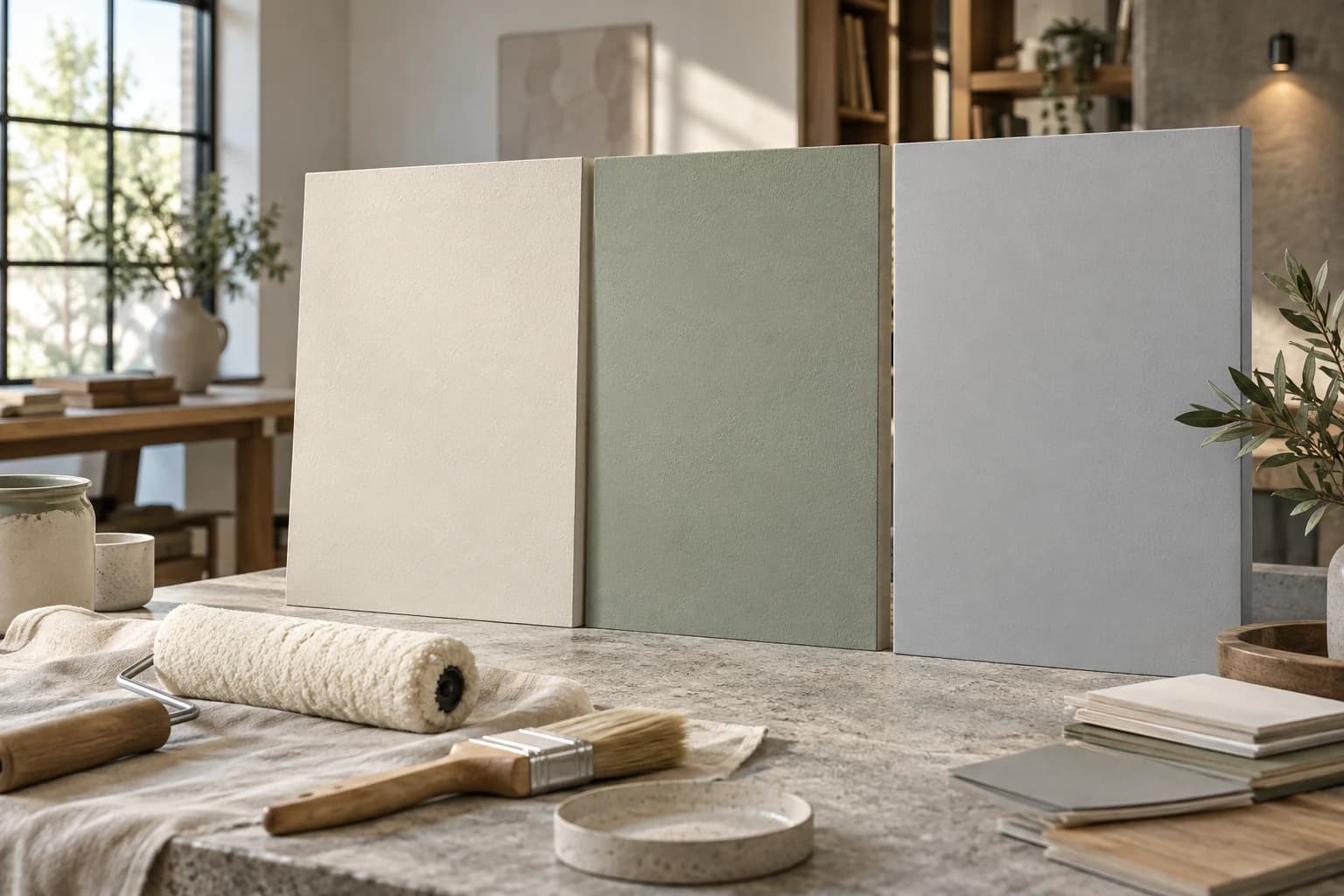
The best wall paint is a product specified for the surface and room use, with suitable sheen and verified cleaning performance. Start by comparing products intended for interior walls, then check specific suitability for moisture exposure, timber or exterior use. A label such as “plastic” or “acrylic” does not establish quality, service life or price.
Prepared by SMD Decoration · Content and references updated: 11 October 2026
This guide compares paint families and their limits. Keep paint type separate from colour selection, and request the exact product name and technical data sheet before buying materials or accepting a quotation.

Compare wall paint types
| Label | What to compare | What to verify |
|---|---|---|
| Water-based / “plastic” | A product intended for interior walls | Cleaning performance and permitted substrates |
| Acrylic / latex | Product formulation; labels can overlap | Interior or exterior use and binder type |
| Oil / alkyd | A system suited to the required surface and details | Solvent, drying and coat compatibility |
| Silicone | The specific product's intended application | Water repellence versus waterproofing |
1. Water-based or “plastic” paint
“Plastic paint” is a market term that does not establish performance by itself. Sherwin-Williams discusses water-based and oil-based interior options according to use [1]. Compare named products instead of assuming every water-based paint is inexpensive or unsuitable for moisture. For timber, check permitted substrates and preparation: some latex products allow this use [6].

2. Oil or alkyd paint
The manufacturer's guidance identifies alkyd as an option for certain trim and stain-resistant finishes [1]. It is not the automatic choice for every wall. Check tool cleaning, solvent and recoating instructions for the selected product, then discuss suitability with the contractor. “Oil-based” alone does not establish waterproofing performance.


3. Latex paint
Latex and acrylic are not always separate product categories: Solo is described as an acrylic latex paint [2]. Do not assign one consumption rate or drying time to all products, or treat a mild odour as sufficient evidence of emissions performance.
4. Acrylic paint
A particular acrylic formulation may permit several applications, but those permissions remain product-specific [2]. Ask for a product intended for your actual wall and a compatible primer. This guide does not assume that every acrylic paint suits every facade or retains its appearance under all conditions.
5. Silicone paint
As a documented example, Teknos describes SILOKSAN FACADE as a water-repellent, vapour-permeable coating for exterior mineral substrates [3]. That does not prove that every “silicone” paint suits bathrooms, prevents mould or replaces waterproofing. Specify the location, substrate and water exposure before approving the product.
Sheen is separate from paint type
Flat, satin, semi-gloss and gloss describe appearance rather than the paint family. The sheen guide explains that reflection affects colour perception and that some flat products are washable [4]. Do not judge cleaning performance from “matte” alone. Assess colour and sheen together in the room.
A decision checklist before buying
- Identify an interior wall, facade, timber or metal surface and record its current condition.
- Write down the requirement: frequent cleaning, a subdued appearance or environmental exposure. A general product label is insufficient.
- Request technical and safety data sheets for the exact product and finish available in your project market.
- Approve a colour and sheen sample in the room, then record the product name and colour code.
- Require the quotation to identify preparation, primer, coats, area and acceptance arrangements.
- Keep product details, invoices and care instructions for future repairs.
Preparation, quantity and handover
Select a primer for the substrate's needs. Primer guidance lists functions including adhesion and stain blocking [7]. There is no universal rule requiring three coats on every wall. Request the specified product system rather than treating a general example as a requirement for all projects.
Estimated litres = paintable area × number of coats ÷ coverage per coat. Use a rate consistent with the data sheet's basis and review practical waste with the supplier. If the stated coverage already refers to a complete system, do not count the coats again. Avoid an unsourced consumption range.
Surface drying, recoating and full cure are different milestones. Print-resistance guidance stresses curing before use and notes longer curing in cool or humid conditions [5]. Agree on handover and cleaning instructions for the actual product and conditions, without promising a universal drying time or service life.
Examples of colour selection in a room


For colour coordination after selecting the paint type, see the colour wheel and colour principles.
How to select paint for each space
For a living room, begin with room use, colour and a sheen that works under the actual lighting. In frequently touched corridors, request the selected product's cleaning and care specifications. Near water, distinguish wall-system protection from decorative paint; investigate wetting before choosing a colour. For doors and trim, compare systems approved for the actual timber or metal substrate rather than transferring wall-paint specifications automatically.
A worked quantity example
Illustrative calculation: a net area of 80 m², two coats and an assumed product-data-sheet rate of 10 m²/litre per coat gives 80 × 2 ÷ 10 = 16 litres before waste. These values demonstrate the calculation; they do not recommend coverage or coat count. Deduct openings according to the measurement method, separate areas requiring different products, then review pack sizes and practical waste with the supplier.
What should a painting quotation include?
Request a schedule identifying room, substrate, area, repairs and exclusions, named primer and finish, colour code and sheen, sample approval, furniture protection, application sequence, care and acceptance instructions. These details make quotations more comparable than a price per square metre alone.
Also see oil-based paint for doors and trim, why white paint turns yellow and the colour wheel for the next selection decisions.
Technical references
- Sherwin-Williams — How to Choose Interior Paint
- Sherwin-Williams — Solo 100% Acrylic Interior/Exterior Latex Paint
- Teknos — SILOKSAN FACADE: product description and technical data sheet, 2024-07-02
- Sherwin-Williams — Shine On, Shine Off: Gloss and Sheen
- Sherwin-Williams — How to Fix Poor Print Resistance
- Sherwin-Williams — The Best Ways to Match Paint to Surfaces
- Sherwin-Williams — How to Choose Primer
Start your dream project today with SMD Decoration
Your space, your vision. SMD Decoration offers interior design, fit-out and renovation in Turkey and Arab markets: homes, apartments, villas, offices, hotels, restaurants, healthcare, education and exhibitions. Reflect your identity, needs and budget.
Explore finishes, painting, upholstery, custom furniture and lighting in modern, classic, contemporary, industrial or eco-conscious styles. Agree services, execution details and handover before work.
SMD Decoration websites
- Main website: smddecoration.com
- Turkey: smddecoration.net.tr
- Oman, Kuwait & Bahrain: turkiyedecoration.com
- Qatar: smddecoration.qa
- UAE: smddecoration.ae
- Saudi Arabia: smddecoration.sa
- Saudi Arabia — additional site: smddecoration.net
- Libya: smddecoration.info
- Iraq: smddecoration.site
- Syria: smddecoration-syria.com
SMD accepts conventional currencies and bank transfers; Bitcoin and other cryptocurrencies are not accepted.
Bring your vision to life with SMD
Share your city, wall photos, substrate condition, area and preferred colours. Discuss product, colour and sheen selection, sample approval and an agreed painting scope for your project.
Email: info@smddecoration.com
Project enquiry