
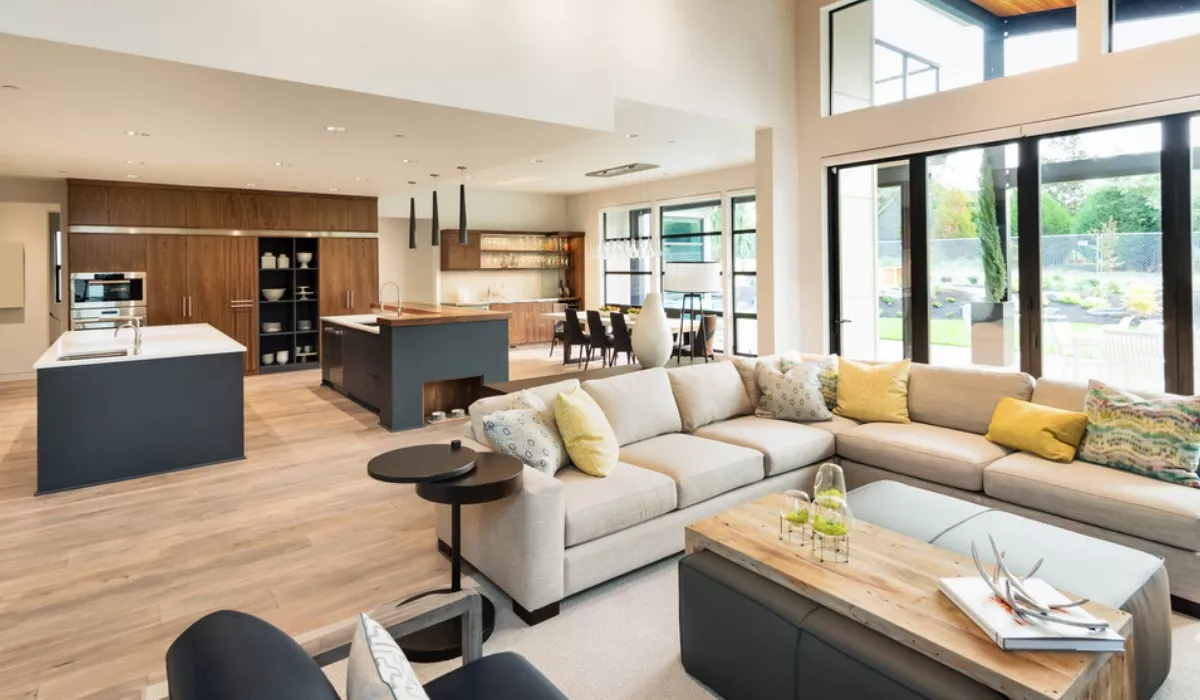
Choose an interior design style by starting with what the room must do, then translating that brief into layout, furniture, materials and colour. Modern, classic and contemporary are descriptions of choices, not quality grades or guarantees of comfort. Begin with measured space, furniture worth keeping and an agreed budget before collecting conflicting inspiration images.
Define the room before naming its style
Record who uses the room, when they use it and what currently causes difficulty: obstructed movement, exposed storage, an unsuitable seat or a screen reflection. Locate doors, windows, sockets and existing furniture using actual dimensions. Similar-looking rooms may need different arrangements because their users live differently.
Separate items to retain, essential functions and preferences open to testing. An appropriate sofa and a favourite rug can provide the starting palette. Replacing them merely to match a photograph may consume the budget without solving the original problem.

A practical comparison of interior directions
| Direction | What to explore | What to check |
|---|---|---|
| Modern with simple lines | Clear furniture forms, restrained detailing and organised storage | Actual seating comfort, edges and storage; simplicity does not remove functional needs |
| Classic or classically inspired | Visual symmetry, selected mouldings, fabrics and detailing | Detail scale against ceiling height and furniture, plus cleaning and maintenance |
| Contemporary | A composition of forms, materials and approaches used today | Define the intended result through samples; the label establishes neither specification nor environmental performance |
| Locally inspired Arab elements | A craft piece, pattern or seating arrangement meaningful to the household | Identify the cultural reference, privacy and use; Arab homes do not follow one fixed formula |
| A considered mix | A shared colour or formal language with a deliberately contrasting piece | Maintain a relationship between elements rather than competing focal points on every surface |
This is an editorial comparison for choosing, not an exhaustive historical classification or popularity ranking. The V&A account of Modernism connects functional thinking with clean lines and reduced ornament. Historically, “modern” therefore does not mean everything newly released. Define the intended look through a sample, image and detail when requesting a quotation.
Use a trend as a testable idea
Translate inspiration into one decision: an accent colour in a replaceable item, texture in a fabric, or a light fitting suited to its task. Tie expensive or difficult-to-change elements to a clear need and a reviewed detail, rather than purchasing a complete matching collection because its images are circulating.
Ask what supports a claim such as “most popular”: which market, period and data source? This guide does not rank trends for a particular year. A valued older piece can sit within a fresh composition if its condition, dimensions and purpose are appropriate.
Review material, colour and lighting together
- Samples: place colours beside retained flooring, fabric and timber; inspect them on site in daylight and under the proposed evening lighting.
- Use: check texture, edges, care instructions and product identity instead of relying on labels such as premium or natural.
- Lighting: trial reading, seating and screen viewing in their actual positions. Review reflections, controls and maintenance access with relevant specialists.
- Environmental claims: request the identified product, supporting document and its scope. A green colour, timber appearance or style name establishes no sustainability performance.
The published objectives of the ASID materials toolkit course include comparing products through transparency documents and carbon-impact resources. This refers to public objectives, not course completion or certification of a product.
Worked decision: keep the sofa, review the table
Suppose a grey sofa and timber cabinet will remain in a living-room refresh. Before requesting a “luxury modern” look, record the sofa dimensions, cabinet opening, entrance route and storage needs. Compare two tables using their actual footprints and trial access from the seats and door operation. Review rug and curtain samples beside the retained pieces.
A different table, lighting and fabric might achieve the brief without replacing every item. Testing might also reveal that layout matters more than colour. This is a hypothetical decision process, not an executed project or a universal furniture dimension.
Turn inspiration into a defined delivery scope
- Select a small set of images and state exactly which features you want and which you do not.
- Confirm use, measured dimensions, retained items and furniture arrangement.
- Review coordinated samples with material, colour, finish and size identified.
- Separate design, supply, installation, services, delivery, exclusions and warranty in the quotation.
- Compare alternatives of equivalent specification and record agreed changes before purchasing.
- At handover, trial doors, drawers, seating and lighting; assign and document outstanding corrections.
A style name alone sets neither a rate per square metre nor a programme. Quantities, detailing, site condition and procurement affect both. Compare defined scope rather than accepting an unsupported savings percentage or standard deadline.
Further reading: Architecture and interior design terms · Room-by-room storage.
Develop a clear interior brief with SMD Decoration
Share photographs, measured dimensions, furniture to retain, visual references and your target budget. We can discuss a concept and service scope suited to the project, with details, cost and programme established after reviewing the inputs. Contact the SMD team.
+90 553 904 12 12
Discuss your project on WhatsApp+966 50 498 6649
Discuss your project on WhatsAppEmail: info@smddecoration.com
SMD websites: Main website · Türkiye · Oman, Kuwait and Bahrain · Qatar · United Arab Emirates · Saudi Arabia · Additional Saudi website · Libya · Iraq · Syria.