
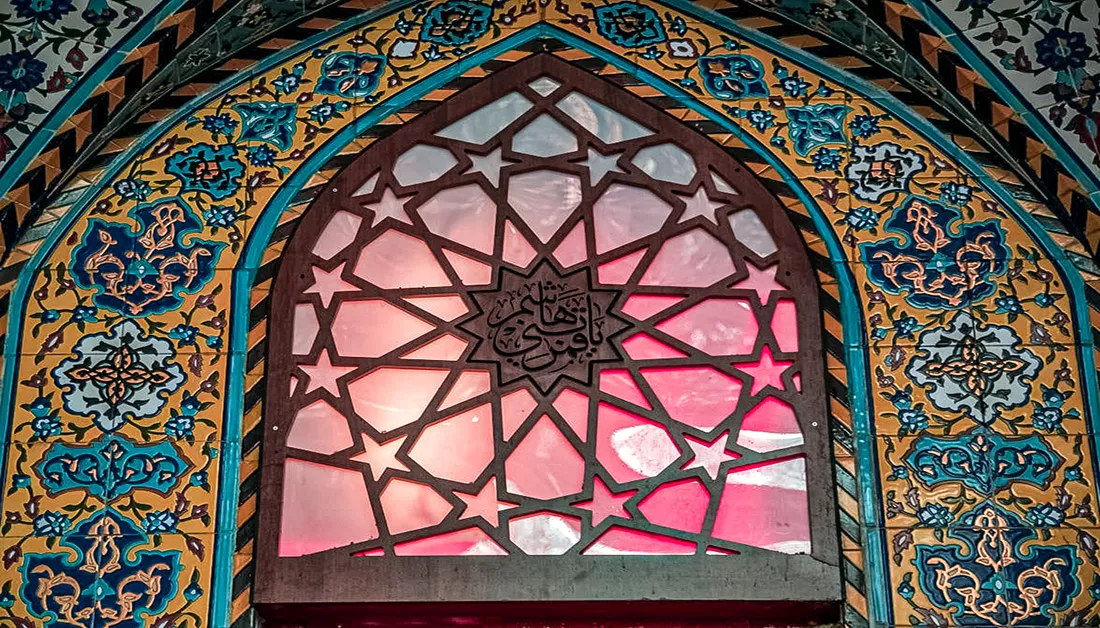
Ornament can be read through geometric, vegetal, calligraphic and figural motifs, including human or animal forms. Several types may share one object. Ornament reveals aspects of artistic practice, technique, taste and cultural context, but one shape cannot establish a culture or date. A stronger reading connects the image with the object’s source, place of production, period, material and function.
Classify ornament by its visual vocabulary
| Type | What to observe | What an image alone cannot establish |
|---|---|---|
| Geometric | Circles, polygons, stars, interlace and repetition | Production place, date or pattern origin. |
| Vegetal | Leaves, flowers and stems, naturalistic or transformed | Exact plant identity or a fixed symbolic meaning. |
| Calligraphic | Letters, words and written compositions | Reading or attribution without checking. |
| Figural | Human, animal or imaginary forms | Function, meaning and historical setting. |
This is a vocabulary, not an exhaustive universal classification. A geometric frame can contain writing, and foliage can intertwine with a figure. Terminology varies between studies. Describe what is visible precisely and state the context in which a term is used.

How ornament works: units, repetition and surfaces
Look for the repeated unit and how it sits beside, rotates around or interlaces with others. Circles, polygons and axes help explain geometric organisation. A vegetal leaf or flower can be transformed into a simplified motif rather than a botanical copy.
Distinguish form from technique. Incising, carving, painting, inlay and weaving are making processes, not equivalent cultures or motif types. A related pattern can appear in wood, stone or fabric, with material, tools and scale changing its details and execution.
Calligraphic ornament conveys text
Writing may dominate a composition or share it with foliage and geometry. The Met explains that calligraphy transmits text even when ornamental. Have the wording, meaning and letterforms checked before turning it into an artwork or surface finish.
Letter-like shapes do not establish correct Arabic or a Kufic script. Changing scale, separating letters or repeating a fragment may affect reading. For contemporary work, record the text, source, approved version and cropping boundaries, then test legibility in its intended position.
Islamic ornament is a context containing several types
Geometry, vegetal patterns and calligraphy appear across arts of the Islamic world and can combine with figural forms in particular works. Islamic describes broad historical and cultural contexts; it is not always a motif category equivalent to geometric.
The Met’s study documents figural work in secular settings and distinguishes it from religious art and architecture. Avoid extending animal ornament to every mosque or removing its presence from this entire artistic history. Read the specific work, function and period without presenting one design as representative of every community or making a religious ruling.
Read history and culture through evidence
Ask about place, period, material, function and known maker or workshop, then compare documented works rather than generalising about a continent. The Met’s past Pattern, Color, Light exhibition shows decorative ideas continuing across political and religious boundaries in Near Eastern examples dating approximately 500–1000.
Connections make a motif a starting point for research rather than a conclusive identity label. African ornament is not uniformly bright, nor European ornament uniformly advanced. Each region contains varied periods, materials and uses. Similarly, a figure or leaf does not automatically carry a particular meaning such as strength or eternity; that interpretation needs object-specific evidence.
A documented Granada limestone panel
The Met records Panel with Geometric Pattern and Benedictory Inscriptions, object 2011.182, as carved limestone made in Granada, Spain, dated late thirteenth to mid-fourteenth century. Geometry and writing share the object, illustrating how motif types combine within a specific context.
The museum proposes possible original functions without resolving every interpretation. Keep the distinction between collection information and an interpretive possibility. A similar star or interlace on a modern product does not establish Granada origin or the same date, and a photograph does not identify the stone in every comparable product.

Choose ornament for a contemporary interior
Decide whether ornament is a focal artwork, border, textile, screen or part of a floor or wall. Trial unit scale, contrast and repeat with furniture, lighting and viewing distance. One considered element may work better than competing patterns across every surface.
Distinguish contemporary interpretation from an antique, historical replica or restoration. Name a reference accurately where used and verify authority to use the image or drawing. Specialist review is needed before interventions in heritage buildings. A new design can develop its own arrangement while honestly describing its relationship to the source.
From inspiration to a reviewable sample
- Record the reference, source and supported date, separating facts from assumptions.
- Define motif, material, position, dimensions and viewing distance.
- Draw repeat units, boundaries, corners and relationships to openings and services.
- Have any text checked and trial scale, colour and legibility.
- Approve a sample in the proposed material and finish; review cleaning and repair.
- Define fabrication, supports, review responsibilities, changes and handover.
These steps preserve the reference’s value while turning inspiration into a clear design decision. Visual appeal does not establish material or support suitability; review those against the product and premises.
Sources and the historical example
Sources checked on 20 October 2026. Classification essays are by The Met’s Department of Islamic Art, October 2001; Pattern, Color, Light was a 2015–2016 exhibition. The historical example is object 2011.182, whose details should not be transferred to every similar ornament. Selection and execution guidance is proposed SMD practice.
- The Met — Geometric Patterns in Islamic Art
- The Met — Vegetal Patterns in Islamic Art
- The Met — Calligraphy in Islamic Art
- The Met — Figural Representation in Islamic Art
- The Met — Panel with Geometric Pattern and Benedictory Inscriptions,2011.182
- The Met — Pattern, Color, Light: Architectural Ornament in the Near East(500–1000)
Choose ornament for your space with SMD Decoration
Share a reference and its source if known, photographs, dimensions, the proposed material and intended use. We can discuss scale, repeat, colours, samples and available fabrication or execution scope while respecting the reference’s context and your project needs. Contact us about your project.
+90 553 904 12 12
Discuss your project on WhatsApp+966 50 498 6649
Discuss your project on WhatsAppEmail: info@smddecoration.com
SMD websites: Main website · Türkiye · Oman, Kuwait and Bahrain · Qatar · United Arab Emirates · Saudi Arabia · Additional Saudi website · Libya · Iraq · Syria.